
SOA Security Lab - S90.20무료 덤프문제 풀어보기
Service Consumer A sends a request message to Service A (1), after which Service A sends a request message to Service B (2). Service B forwards the message to have its contents calculated by Service C (3). After receiving the results of the calculations via a response message from Service C (4), Service B then requests additional data by sending a request message to Service D (5). Service D retrieves the necessary data from Database A (6), formats it into an XML document, and sends the response message containing the XML-formatted data to Service B (7).
Service B appends this XML document with the calculation results received from Service C, and then records the entire contents of the XML document into Database B (8). Finally, Service B sends a response message to Service A (9) and Service A sends a response message to Service Consumer A (10).

Services A, B and D are agnostic services that belong to Organization A and are also being reused in other service compositions. Service C is a publicly accessible calculation service that resides outside of the organizational boundary. Database A is a shared database used by other systems within Organization A and Database B is dedicated to exclusive access by Service B.
Service B has recently been experiencing a large increase in the volume of incoming request messages. It has been determined that most of these request messages were auto-generated and not legitimate. As a result, there is a strong suspicion that the request messages originated from an attacker attempting to carry out denial-of-service attacks on Service B.
Additionally, several of the response messages that have been sent to Service A from Service B contained URI references to external XML schemas that would need to be downloaded in order to parse the message data. It has been confirmed that these external URI references originated with data sent to Service B by Service C.
The XML parser currently being used by Service A is configured to download any required XML schemas by default. This configuration cannot be changed.
What steps can be taken to improve the service composition architecture in order to avoid future denial-of-service attacks against Service B and to further protect Service A from data access-oriented attacks?
Service B appends this XML document with the calculation results received from Service C, and then records the entire contents of the XML document into Database B (8). Finally, Service B sends a response message to Service A (9) and Service A sends a response message to Service Consumer A (10).
Services A, B and D are agnostic services that belong to Organization A and are also being reused in other service compositions. Service C is a publicly accessible calculation service that resides outside of the organizational boundary. Database A is a shared database used by other systems within Organization A and Database B is dedicated to exclusive access by Service B.
Service B has recently been experiencing a large increase in the volume of incoming request messages. It has been determined that most of these request messages were auto-generated and not legitimate. As a result, there is a strong suspicion that the request messages originated from an attacker attempting to carry out denial-of-service attacks on Service B.
Additionally, several of the response messages that have been sent to Service A from Service B contained URI references to external XML schemas that would need to be downloaded in order to parse the message data. It has been confirmed that these external URI references originated with data sent to Service B by Service C.
The XML parser currently being used by Service A is configured to download any required XML schemas by default. This configuration cannot be changed.
What steps can be taken to improve the service composition architecture in order to avoid future denial-of-service attacks against Service B and to further protect Service A from data access-oriented attacks?
정답: A
Service A exchanges messages with Service B multiple times during the same runtime service activity. Communication between Services A and B has been secured using transport-layer security. With each service request message sent to Service B (1A. IB), Service A includes an X.509 certificate, signed by an external Certificate Authority (CA).
Service B validates the certificate by retrieving the public key of the CA (2A. 2B) and verifying the digital signature of the X.509 certificate. Service B then performs a certificate revocation check against a separate external CA repository (3A, 3B). No intermediary service agents reside between Service A and Service B.

To fulfill a new security requirement, Service A needs to be able to verify that the response message sent by Service B has not been modified during transit. Secondly, the runtime performance between Services A and B has been unacceptably poor and therefore must be improved without losing the ability to verify Service A's security credentials. It has been determined that the latency is being caused by redundant security processing carried out by Service B.
Which of the following statements describes a solution that fulfills these requirements?
Service B validates the certificate by retrieving the public key of the CA (2A. 2B) and verifying the digital signature of the X.509 certificate. Service B then performs a certificate revocation check against a separate external CA repository (3A, 3B). No intermediary service agents reside between Service A and Service B.
To fulfill a new security requirement, Service A needs to be able to verify that the response message sent by Service B has not been modified during transit. Secondly, the runtime performance between Services A and B has been unacceptably poor and therefore must be improved without losing the ability to verify Service A's security credentials. It has been determined that the latency is being caused by redundant security processing carried out by Service B.
Which of the following statements describes a solution that fulfills these requirements?
정답: A
Service Consumer A sends a request message with a Username token to Service A (1).
Service B authenticates the request by verifying the security credentials from the Username token with a shared identity store (2), To process Service Consumer A's request message. Service A must use Services B, C, and D.
Each of these three services also requires the Username token (3. 6, 9) in order to authenticate Service Consumer A by using the same shared identity store (4, 7, 10). Upon each successful authentication, each of the three services (B, C, and D) issues a response message back to Service A (5, 8, 11).
Upon receiving and processing the data in all three response messages, Service A sends its own response message to Service Consumer A (12).
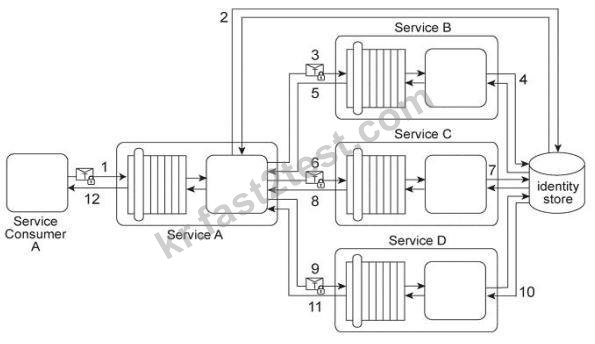
There are plans implement a single sign-on security mechanism in this service composition architecture. The service contracts for Services A, C, and D can be modified with minimal impact in order to provide support for the additional messaging requirements of the single sign-on mechanism. However, Service B's service contract is tightly coupled to its implementation and, as a result, this type of change to its service contract is not possible as it would require too many modifications to the underlying service implementation.
Given the fact that Service B's service contract cannot be changed to support single sign- on, how can a single sign-on mechanism still be implemented across all services?
Service B authenticates the request by verifying the security credentials from the Username token with a shared identity store (2), To process Service Consumer A's request message. Service A must use Services B, C, and D.
Each of these three services also requires the Username token (3. 6, 9) in order to authenticate Service Consumer A by using the same shared identity store (4, 7, 10). Upon each successful authentication, each of the three services (B, C, and D) issues a response message back to Service A (5, 8, 11).
Upon receiving and processing the data in all three response messages, Service A sends its own response message to Service Consumer A (12).
There are plans implement a single sign-on security mechanism in this service composition architecture. The service contracts for Services A, C, and D can be modified with minimal impact in order to provide support for the additional messaging requirements of the single sign-on mechanism. However, Service B's service contract is tightly coupled to its implementation and, as a result, this type of change to its service contract is not possible as it would require too many modifications to the underlying service implementation.
Given the fact that Service B's service contract cannot be changed to support single sign- on, how can a single sign-on mechanism still be implemented across all services?
정답: B