
MRCPUK Endocrinology and Diabetes (Specialty Certificate Examination) - SEND무료 덤프문제 풀어보기
A 16-year-old boy was referred to the diabetes clinic following the discovery of a random plasma glucose concentration of 18.0 mmol/L. His general practitioner had begun treatment with metformin. The patient had a body mass index of 35 kg/m2 (18-25). He had had problems throughout his childhood, and had been taken out of school and was educated at home by his mother. He was attending the ophthalmology clinic for visual problems.
On examination, he was obese. He had hearing aids in both ears and evidence of acanthosis nigricans. Neither parent had a history of diabetes mellitus.
What is the most likely diagnosis?
On examination, he was obese. He had hearing aids in both ears and evidence of acanthosis nigricans. Neither parent had a history of diabetes mellitus.
What is the most likely diagnosis?
정답: E
An 18-year-old woman was referred by her general practitioner for further investigation of "funny turns" during which she developed palpitations, sweating, tremor, hunger, anxiety and paraesthesiae; all of these symptoms were relieved immediately by a sugary drink. She was otherwise well and was not taking any regular medication. There was a family history of type 1 diabetes mellitus. A spontaneous hypoglycaemic episode had not been captured and she was admitted to the diabetes/endocrine ward for a 72-hour fast. Her renal function was normal.
After a 12-hour fast she experienced her typical symptoms. Urinalysis showed no urinary ketones.
Investigations after 12-h fast:
fasting plasma glucose 2.0 mmol/L (3.0-6.0)
plasma insulin56 pmol/L (<21 after hypoglycaemia)
serum C-peptide514 pmol/L (180-360)
What is the most appropriate next step in management?
After a 12-hour fast she experienced her typical symptoms. Urinalysis showed no urinary ketones.
Investigations after 12-h fast:
fasting plasma glucose 2.0 mmol/L (3.0-6.0)
plasma insulin56 pmol/L (<21 after hypoglycaemia)
serum C-peptide514 pmol/L (180-360)
What is the most appropriate next step in management?
정답: D
A 15-year-old boy was referred by the school nurse because she was concerned about his weight. There was no past history of note. He was not taking any medication. His height was 1.61 m and he weighed 70.5 kg.
Investigations: growth chartsee image
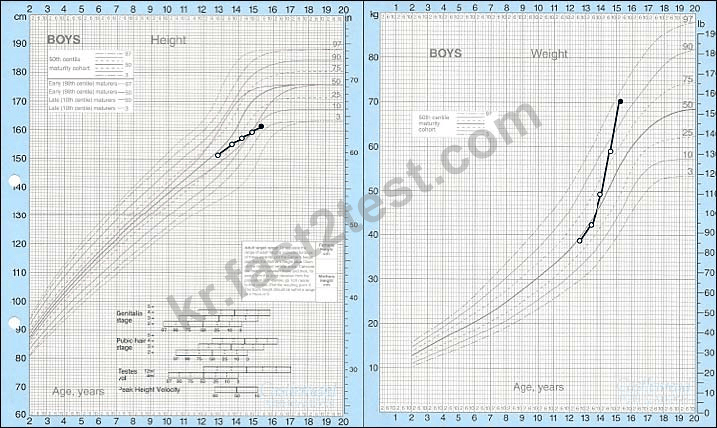
What is the most likely diagnosis?
Investigations: growth chartsee image
What is the most likely diagnosis?
정답: A
A 72-year-old man with a 12-year history of type 2 diabetes mellitus was found to have carcinoma of the bladder. He was taking metformin; however, this was stopped because of his deteriorating renal function.
On examination, his weight was 95 kg and his body mass index was 32 kg/m2 (18-25).
Investigations:
serum sodium143 mmol/L (137-144)
serum potassium4.4 mmol/L (3.5-4.9)
serum creatinine175 umol/L (60-110)
estimated glomerular filtration rate (MDRD)27 mL/min/1.73 m2 (>60)
haemoglobin A1c64 mmol/mol (20-42)
What is the most appropriate addition to his medication?
On examination, his weight was 95 kg and his body mass index was 32 kg/m2 (18-25).
Investigations:
serum sodium143 mmol/L (137-144)
serum potassium4.4 mmol/L (3.5-4.9)
serum creatinine175 umol/L (60-110)
estimated glomerular filtration rate (MDRD)27 mL/min/1.73 m2 (>60)
haemoglobin A1c64 mmol/mol (20-42)
What is the most appropriate addition to his medication?
정답: C
A 61-year-old woman was found incidentally to have a raised serum calcium concentration. She was otherwise well. Her father had undergone a neck operation many years previously.
Investigations:
serum corrected calcium2.78 mmol/L (2.20-2.60)
plasma parathyroid hormone10.8 pmol/L (0.9-5.4)
Her general practitioner thought she had primary hyperparathyroidism.
Which further finding is most likely to cast doubt upon this diagnosis?
Investigations:
serum corrected calcium2.78 mmol/L (2.20-2.60)
plasma parathyroid hormone10.8 pmol/L (0.9-5.4)
Her general practitioner thought she had primary hyperparathyroidism.
Which further finding is most likely to cast doubt upon this diagnosis?
정답: C
A 48-year-old man with an 8-year history of type 2 diabetes mellitus was referred because of poor glycaemic control. He had a history of myocardial infarction complicated by previous congestive cardiac failure. His current medication comprised metformin 850 mg three times daily and gliclazide 80 mg once daily. He had gained weight and his body mass index was 31 kg/m2 (18-25).
Investigations:
serum sodium143 mmol/L (137-144)
serum potassium4.4 mmol/L (3.5-4.9)
serum creatinine136 umol/L (60-110)
haemoglobin A1c74 mmol/mol (20-42)
According to NICE guidelines (CG87, May 2009), what is the most appropriate immediate next step in management to improve his glycaemic control?
Investigations:
serum sodium143 mmol/L (137-144)
serum potassium4.4 mmol/L (3.5-4.9)
serum creatinine136 umol/L (60-110)
haemoglobin A1c74 mmol/mol (20-42)
According to NICE guidelines (CG87, May 2009), what is the most appropriate immediate next step in management to improve his glycaemic control?
정답: E
A 23-year-old woman presented to the outpatient clinic complaining of an inability to lose weight and irregular menses. Her food diary suggested that she consumed only 900 kilocalories daily. She had previously been found to have hypothyroidism and was treated with levothyroxine 75 micrograms daily.
On examination, her body mass index was 40.2 kg/m2 (18-25).
Investigations:
serum testosterone3.6 nmol/L (0.5-3.0) plasma follicle-stimulating hormone3.0 U/L (2.5-10.0) plasma luteinising hormone9.0 U/L (2.5-10.0) serum thyroid-stimulating hormone4.6 mU/L (0.4-5.0) serum free T412.8 pmol/L (10.0-22.0)
What is the most appropriate next step?
On examination, her body mass index was 40.2 kg/m2 (18-25).
Investigations:
serum testosterone3.6 nmol/L (0.5-3.0) plasma follicle-stimulating hormone3.0 U/L (2.5-10.0) plasma luteinising hormone9.0 U/L (2.5-10.0) serum thyroid-stimulating hormone4.6 mU/L (0.4-5.0) serum free T412.8 pmol/L (10.0-22.0)
What is the most appropriate next step?
정답: B
A 37-year-old woman presented with a 2-year history of increasingly frequent flushing episodes. She described alternating loose bowel motions and constipation. She had also noted menstrual irregularity. She had no respiratory symptoms. She denied headache or chest pain, but complained of palpitations.
On examination, she appeared well. Her blood pressure was 128/82 mmHg.
Investigations:
serum thyroid-stimulating hormone0.8 mU/L (0.4-5.0)
What is the most appropriate next investigation?
On examination, she appeared well. Her blood pressure was 128/82 mmHg.
Investigations:
serum thyroid-stimulating hormone0.8 mU/L (0.4-5.0)
What is the most appropriate next investigation?
정답: D
A 48-year-old man presented with an infected ulcer, measuring 2 ? 1 cm, over the right first metatarsal head, with surrounding cellulitis. He had no previous history of diabetes mellitus but had been told by his general practitioner some years previously that his blood glucose was 'borderline'.
On examination, his temperature was 37.4C, his blood pressure was 158/92 mmHg and his body mass index was 31.5 kg/m2 (18-25). His foot pulses were easily palpable but he had a sensory neuropathy.
Investigations:
random plasma glucose16.4 mmol/L
haemoglobin A1c81 mmol/mol (20-42)
What is the most appropriate treatment for his hyperglycaemia?
On examination, his temperature was 37.4C, his blood pressure was 158/92 mmHg and his body mass index was 31.5 kg/m2 (18-25). His foot pulses were easily palpable but he had a sensory neuropathy.
Investigations:
random plasma glucose16.4 mmol/L
haemoglobin A1c81 mmol/mol (20-42)
What is the most appropriate treatment for his hyperglycaemia?
정답: A
A 30-year-old man was reviewed in the diabetes clinic. He had type 1 diabetes mellitus of 6 months' duration, treated with subcutaneous insulin in a basal bolus regimen (short-acting insulin three times daily; long-acting insulin once daily).
Investigations:
haemoglobin A1c52 mmol/mol (20-42)
At what arterialised venous blood glucose threshold would a patient typically expect to develop neuroglycopenic symptoms?
Investigations:
haemoglobin A1c52 mmol/mol (20-42)
At what arterialised venous blood glucose threshold would a patient typically expect to develop neuroglycopenic symptoms?
정답: C
A 61-year-old woman was referred to the blood pressure clinic because of refractory hypertension. One year previously, her blood pressure, urea and electrolytes had been normal. Her current therapy included verapamil modified-release 240 mg daily and doxazosin 16 mg daily.
On examination, she was 1.63 m tall and weighed 90 kg with an elevated waist to hip ratio. Her blood pressure was 182/94 mmHg supine.
Investigations:
serum sodium137 mmol/L (137-144)
serum potassium2.8 mmol/L (3.5-4.9)
serum creatinine79 umol/L (60-110)
plasma renin activity (after 30 min supine)<1.1 pmol/mL/h (1.1-2.7)
plasma aldosterone (after 30 min supine)<135 pmol/L (135-400)
What is the most appropriate investigation?
On examination, she was 1.63 m tall and weighed 90 kg with an elevated waist to hip ratio. Her blood pressure was 182/94 mmHg supine.
Investigations:
serum sodium137 mmol/L (137-144)
serum potassium2.8 mmol/L (3.5-4.9)
serum creatinine79 umol/L (60-110)
plasma renin activity (after 30 min supine)<1.1 pmol/mL/h (1.1-2.7)
plasma aldosterone (after 30 min supine)<135 pmol/L (135-400)
What is the most appropriate investigation?
정답: E
A 17-year-old girl was referred to the transition clinic. She was taking hydrocortisone 10 mg twice daily and fludrocortisone 150 micrograms daily following a failed short tetracosactide (Synacthen@) test 5years previously. She had entered puberty at the age of 10 but had never achieved adult breast development or menarche.
Investigations:
haemoglobin95 g/L (115-165)
MCV124 fL (80-96)
white cell count8.4 ? 109/L (4.0-11.0)
platelet count334 ? 109/L (150-400)
serum sodium138 mmol/L (137-144)
serum potassium4.4 mmol/L (3.5-4.9)
serum urea3.5 mmol/L (2.5-7.0)
serum corrected calcium1.80 mmol/L (2.20-2.60)
serum follicle-stimulating hormone67.9 U/L (2.5-10.0)
serum luteinising hormone56.4 U/L (2.5-10.0)
What is the most likely diagnosis?
Investigations:
haemoglobin95 g/L (115-165)
MCV124 fL (80-96)
white cell count8.4 ? 109/L (4.0-11.0)
platelet count334 ? 109/L (150-400)
serum sodium138 mmol/L (137-144)
serum potassium4.4 mmol/L (3.5-4.9)
serum urea3.5 mmol/L (2.5-7.0)
serum corrected calcium1.80 mmol/L (2.20-2.60)
serum follicle-stimulating hormone67.9 U/L (2.5-10.0)
serum luteinising hormone56.4 U/L (2.5-10.0)
What is the most likely diagnosis?
정답: E