
Microsoft Developing SQL Data Models - 070-768무료 덤프문제 풀어보기
Drag and Drop Question
A database named DB2 uses the InMemory query mode. Users frequently run the following query:

You need to reconfigure the SSAS instance that hosts DB1.
Which three actions should perform in sequence? To answer, move the appropriate actions from the list of actions to the answer area and arrange them in the correct order.

A database named DB2 uses the InMemory query mode. Users frequently run the following query:
You need to reconfigure the SSAS instance that hosts DB1.
Which three actions should perform in sequence? To answer, move the appropriate actions from the list of actions to the answer area and arrange them in the correct order.
정답:
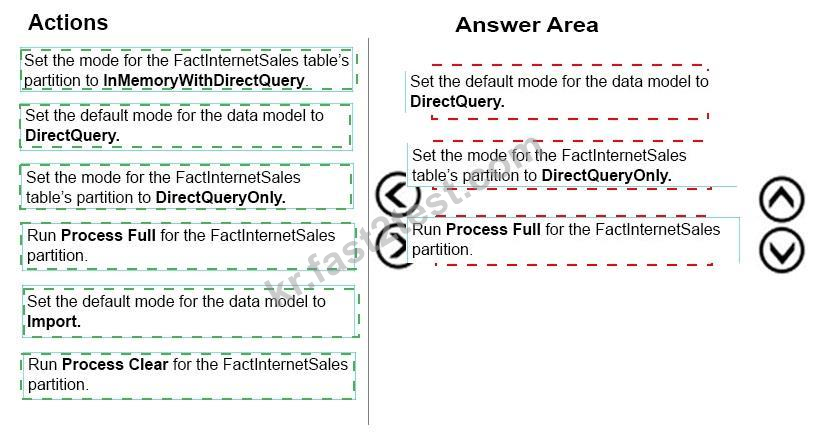
Explanation:
Step 1: Set the default mode for the data model to DirectQuery. You discover that the project has been deployed with the Direct Query Mode option set to OFF.
Step 2: Set the mode for the FactInternetSales table's partition to DirectQueryOnly. Initially, even DirectQuery models are always created in memory. The default query mode for the workspace database is also set toDirectQuery with In-Memory. This hybrid working mode lets you use the cache of imported data for improved performance during the model design process, while validating the model against DirectQuery requirements.
From Scenario: Most queries that use the SalesAnalysis data model use data from a table named FactInternetSales that is 20 gigabyte (GB) in size. Cached data must be available for the FactInternetSales table. All queries accessing the SalesAnalysis model must be executed in near real time.
Step 3: Run Process Full for the FactInternetSales partition. When Process Full is executed against an object that has already been processed, Analysis Services drops all data in the object, and then processes the object. This kind of processing is required when a structural change has been made to an object, for example, when an attribute hierarchy is added, deleted, or renamed
Drag and Drop Question
You need to configure the SalesAnalysis cube to correct the sales analysis by customer calculation.
Which four actions should you perform in sequence? To answer, move the appropriate actions from the list of actions to the answer area and arrange them in the correct order.
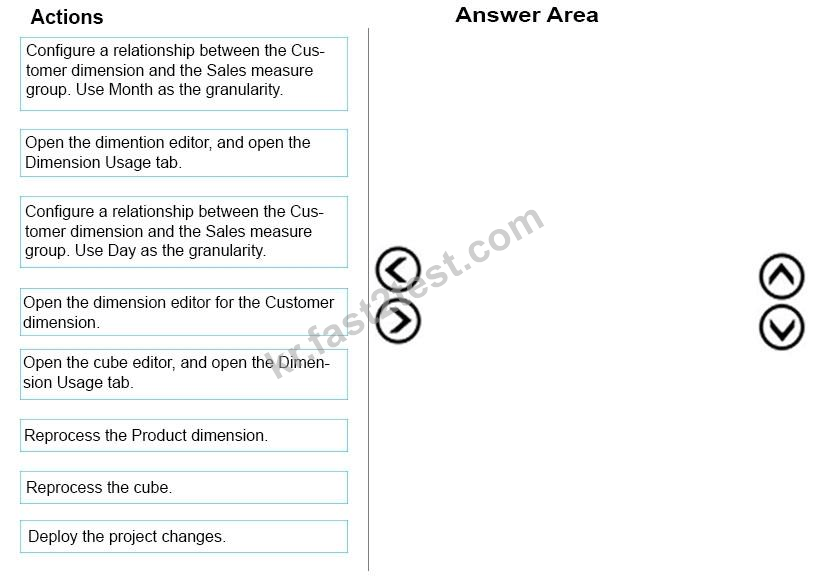
You need to configure the SalesAnalysis cube to correct the sales analysis by customer calculation.
Which four actions should you perform in sequence? To answer, move the appropriate actions from the list of actions to the answer area and arrange them in the correct order.
정답:
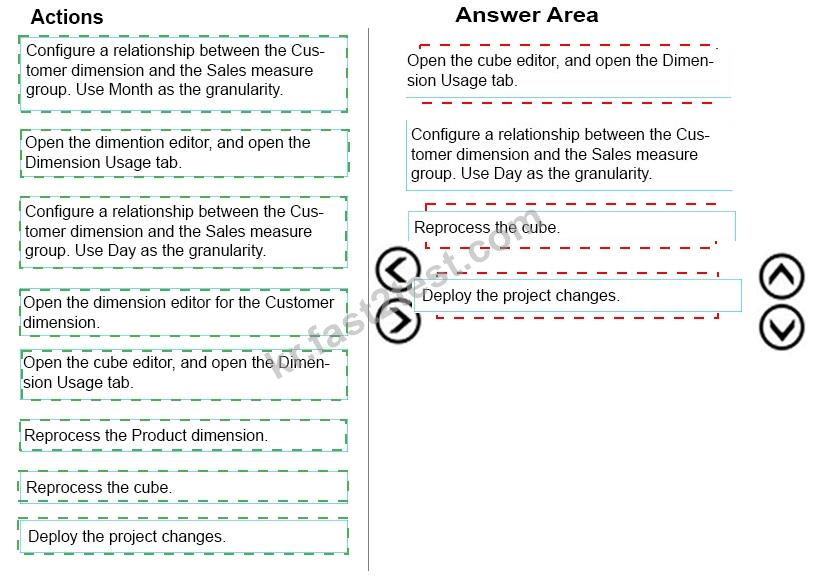
Explanation:
Step 1: Open the cube editor, and open the Dimension Usage tab.
Step 2: Configure a relationship between the Customer dimension and the Sales measure group.
Use Day as the granularity.
From scenario: The SalesAnalysis cube contains a fact table named CoffeeSale loaded from a table named FactSale in the data warehouse. The time granularity within the cube is 15 minutes.
The cube is processed every night at 23:00. You determine that the fact table cannot be fully processed in the expected time. Users have reported slow query response times.
Step 3: Reprocess the cube.
Step 4: Deploy the project changes.
Topic 1, Background
Wide World Importers has multidimensional cubes named SalesAnalysis and ProductSales. The SalesAnalysis cube is refreshed from a relational data warehouse. You have a Microsoft SQL Server Analysis Services instance that is configured to use tabular mode. You have a tabular data model named CustomerAnalysis.
Sales Analysis
The SalesAnalysis cube contains a fact table named CoffeeSale loaded from a table named FactSale in the data warehouse. The time granularity within the cube is 15 minutes. The cube is processed every night at 23:00. You determine that the fact table cannot be fully processed in the expected time. Users have reported slow query response times.
The SalesAnalysis model contains tables from a SQL Server database named SalesDB. You set the DirectQueryMode option to DirectQuery. Data analyst access data from a cache that is up to
24 hours old. Data analyst report performance issues when they access the SalesAnalysis model.
When analyzing sales by customer, the total of all sales is shown for every customer, instead of the customer's sales value. When analyzing sales by product, the correct totals for each product are shown.
Customer Analysis
You are redesigning the CustomerAnalysis tabular data model that will be used to analyze customer sales. You plan to add a table named CustomerPermission to the model. This table maps the Active Directory login of an employee with the CustomerId keys for all customers that the employee manages.
The CustomerAnalysis data model will contain a large amount of data and needs to be shared with other developers even if a deployment fails. Each time you deploy a change during development, processing takes a long time.
Data analysts must be able to analyze sales for financial years, financial quarters, months, and days. Many reports are based on analyzing sales by month.
Product Sales
The ProductSales cube allows data analysts to view sales information by product, city, and time.
Data analysts must be able to view ProductSales data by Year to Date (YTD) as a measure. The measure must be formatted as currency, associated with the Sales measure group, and contained in a folder named Calculations.
Requirements
You identify the following requirements:
- Data available during normal business hours must always be up-to-
date.
- Processing overhead must be minimized.
- Query response times must improve.
- All queries that access the SalesAnalysis model must use cached data
by default.
- Data analysts must be able to access data in near real time.
You are developing a SQL Server Analysis Services (SSAS) tabular project for a Power View solution.
You need to grant permission for salespersons to view only the data based on their sales territory.
What should you do?
You need to grant permission for salespersons to view only the data based on their sales territory.
What should you do?
정답: A
Note: This question is part of a series of questions that present the same scenario. Each question in the series contains a unique solution. Determine whether the solution meets the stated goals.
You deploy a tabular data model to an instance of Microsoft SQL Server Analysis Services (SSAS). The model uses an in-memory cache to store and query data. The data set is already the same size as the available RAM on the server. Data volumes are likely to continue to increase rapidly.
Your data model contains multiple calculated tables.
The data model must begin processing each day at 2:00 and processing should be complete by
4:00 the same day. You observe that the data processing operation often does not complete before 7:00. This is adversely affecting team members.
You need to improve the performance.
Solution: Change the storage mode for the data model to DirectQuery.
Does the solution meet the goal?
You deploy a tabular data model to an instance of Microsoft SQL Server Analysis Services (SSAS). The model uses an in-memory cache to store and query data. The data set is already the same size as the available RAM on the server. Data volumes are likely to continue to increase rapidly.
Your data model contains multiple calculated tables.
The data model must begin processing each day at 2:00 and processing should be complete by
4:00 the same day. You observe that the data processing operation often does not complete before 7:00. This is adversely affecting team members.
You need to improve the performance.
Solution: Change the storage mode for the data model to DirectQuery.
Does the solution meet the goal?
정답: A
설명: (Fast2test 회원만 볼 수 있음)
Drag and Drop Question
You are a business analyst for a retail company that uses a Microsoft SQL Server Analysis Services (SSAS) multidimensional database to track sales.
The database contains the following objects:
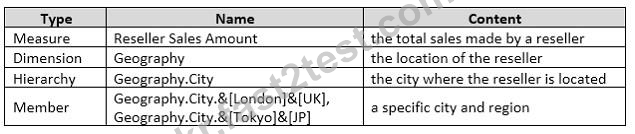
Your company is developing a promotional plaque to recognize the top resellers in the top 10 cities where the company does business. Each plaque must display the sales total for all resellers in the city. In addition, the plaque must display a total for all cities not in the top 10.
You have the following requirements:
You need to provide the information needed for the promotional plaques.
How should you complete the MDX statement? To answer, drag the appropriate MDX segments to the correct locations. Each MDX segment may be used once, more than once, or not at all.
You may need to drag the split bar between panes or scroll to view content. NOTE: Each correct selection is worth one point.

You are a business analyst for a retail company that uses a Microsoft SQL Server Analysis Services (SSAS) multidimensional database to track sales.
The database contains the following objects:
Your company is developing a promotional plaque to recognize the top resellers in the top 10 cities where the company does business. Each plaque must display the sales total for all resellers in the city. In addition, the plaque must display a total for all cities not in the top 10.
You have the following requirements:
You need to provide the information needed for the promotional plaques.
How should you complete the MDX statement? To answer, drag the appropriate MDX segments to the correct locations. Each MDX segment may be used once, more than once, or not at all.
You may need to drag the split bar between panes or scroll to view content. NOTE: Each correct selection is worth one point.
정답:
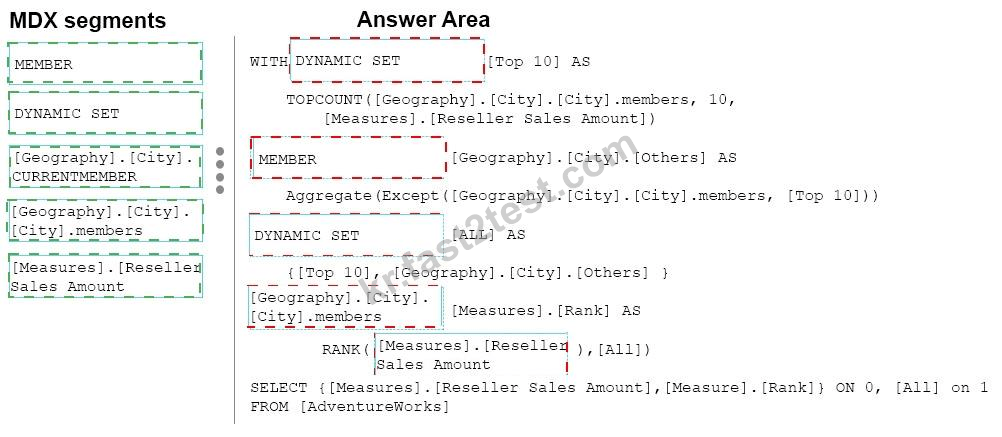
Explanation:
Box 1:DYNAMIC SET
Box 2:MEMBER
Box 3:DYNAMIC SET
Box 4:[Geography].[City].[City].members
Box 5:[Measures].[Reseller Sales Amount]
https://docs.microsoft.com/en-us/sql/mdx/aggregate-mdx
A database named DB2 uses the InMemory query mode. Users frequently run the following query:
You need to ensure no users see the PriorYearSales measure in the field list for the Sales table.
What should you do?
You need to ensure no users see the PriorYearSales measure in the field list for the Sales table.
What should you do?
정답: A
설명: (Fast2test 회원만 볼 수 있음)
Hotspot Question
You have a Microsoft SQL Server Analysis Services (SSAS) multidimensional project.
You are developing a dimension that uses data from the following table:

The ManagerKey column defines a foreign key constraint that references the EmployeeKey column. The table stores employee history information by using slowly changing dimensions (SCD). Changes to EmployeeName, Phone, or ManagerKey are managed as SCD Type 1 changes. Changes to SalesRegion are managed as SCD Type 2 changes.
You create the following attributes, and set the KeyColumns and NameColumn properties to the columns listed in the table below:
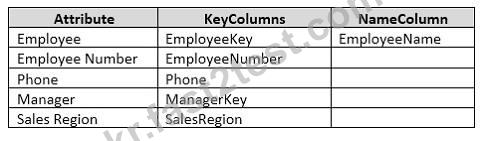
You need to add a parent-child hierarchy to the dimension to enable navigating the organization hierarchy.
In the table below, identify the attribute that you must use for each attribute usage type.
NOTE: Make only one selection in each column.

You have a Microsoft SQL Server Analysis Services (SSAS) multidimensional project.
You are developing a dimension that uses data from the following table:
The ManagerKey column defines a foreign key constraint that references the EmployeeKey column. The table stores employee history information by using slowly changing dimensions (SCD). Changes to EmployeeName, Phone, or ManagerKey are managed as SCD Type 1 changes. Changes to SalesRegion are managed as SCD Type 2 changes.
You create the following attributes, and set the KeyColumns and NameColumn properties to the columns listed in the table below:
You need to add a parent-child hierarchy to the dimension to enable navigating the organization hierarchy.
In the table below, identify the attribute that you must use for each attribute usage type.
NOTE: Make only one selection in each column.
정답:

Explanation:
The ManagerKey column, the Manager attribute, defines a foreign key constraint that references the EmployeeKey column, the Employee attribute.