
Microsoft Operationalizing Machine Learning and Generative AI Solutions - AI-300무료 덤프문제 풀어보기
You are monitoring a fine-tuned large language model deployed in Microsoft Foundry.
You evaluate the model before and after fine-tuning by using the same evaluation dataset.
You review the following evaluation results:
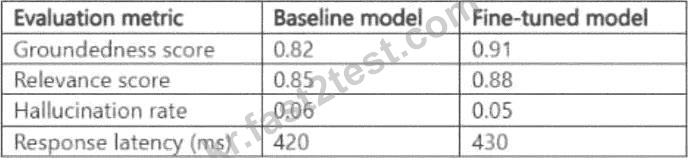
You need to determine whether the fine-tuned model shows improved performance without introducing regression.
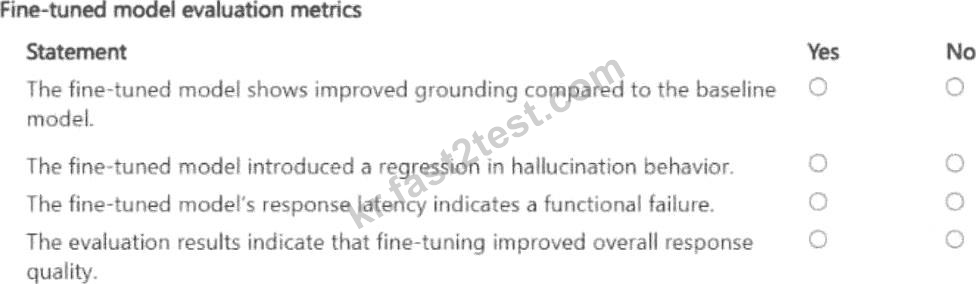
For each of the following statements, select Yes if the statement is true. Otherwise, select No. NOTE: Each correct selection is worth one point.
You evaluate the model before and after fine-tuning by using the same evaluation dataset.
You review the following evaluation results:
You need to determine whether the fine-tuned model shows improved performance without introducing regression.
For each of the following statements, select Yes if the statement is true. Otherwise, select No. NOTE: Each correct selection is worth one point.
정답:
Explanation:
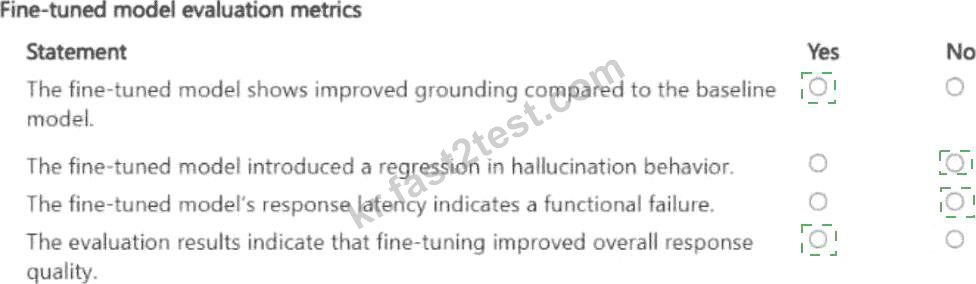
When evaluating a fine-tuned model against the base model using the same evaluation dataset, the interpretation of each metric requires careful analysis. A statement that the fine-tuned model improves on the target task is True if and only if the target metric such as task-specific accuracy, F1 score, or ROUGE score shows a statistically meaningful improvement. A statement about regression on a complementary metric is True if the fine-tuned model ' s score on that metric is meaningfully lower than the base model ' s. In Microsoft Foundry ' s evaluation framework, both pre-fine-tuning and post-fine-tuning results are stored against the same experiment, enabling direct side-by-side comparison. The core principle is that improvement on the primary task is not sufficient if fine-tuning causes degradation on safety or coherence - this is called catastrophic forgetting, and the evaluation dataset is designed to detect it.
Microsoft Learn Reference Topic: Evaluate fine-tuned models in Microsoft Foundry - Compare base and fine- tuned model metrics

You manage an Azure Machine Learning workspace that includes a batch endpoint. You plan to deploy a model to the batch endpoint. You need to configure compute for the deployment. Which compute should you use?
정답: C
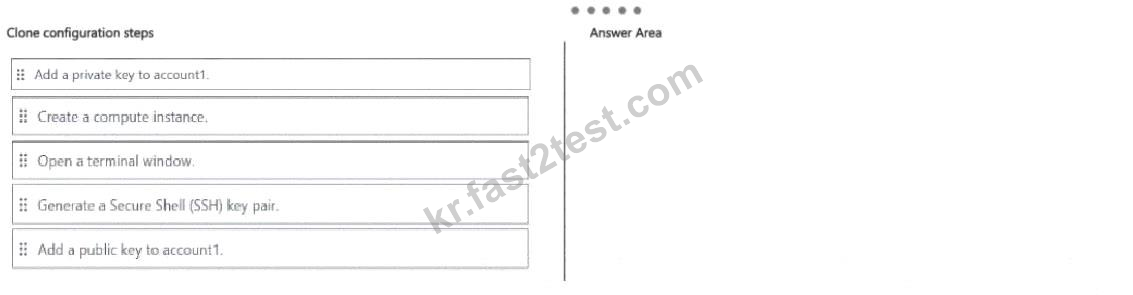
You have an Azure Machine Learning workspace named WS1 and a GitHub account named account! that hosts a private repository named repo1. You need lo done repo1 to make it available directly from WS1. The configuration must maximize the performance of the repo1 clone. Which four actions should you perform in sequence?
정답:

Explanation:

You have an Azure Machine Learning workspace named workspaces.
You must add a datastore that connects an Azure Blob storage container to workspaces. You must be able to configure a privilege level.
You need to configure authentication.
Which authentication method should you use?
You must add a datastore that connects an Azure Blob storage container to workspaces. You must be able to configure a privilege level.
You need to configure authentication.
Which authentication method should you use?
정답: C
You manage an Azure Machine learning workspace. You plan to import data from Azure Data Lake Storage Gen2. You need to build a URL that represents the storage location. Which protocol should you use?
정답: B
You manage an Azure Machine Learning workspace named workspace!.
You plan to author custom pipeline components by using Azure Machine Learning Python SDK v2.
You must transform the Python code into a YAML specification that can be processed by the pipeline service.
You need to import the Python library that provides the transformation functionality.
Which Python library should you import?
정답: C
You need to standardize how Fabrikam Inc. manages machine learning assets.
Which action should you perform first?
Which action should you perform first?
정답: C
설명: (Fast2test 회원만 볼 수 있음)
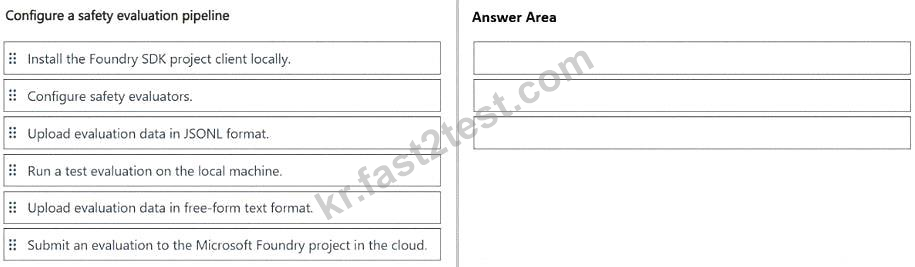
A team validates a generative AI application that produces free-form text responses by using Microsoft Foundry SDK.
The evaluation dataset is registered in the Microsoft Foundry environment.
You need to configure a safety evaluation pipeline that reliably evaluates model outputs for harmful content.
Which three actions should you perform in sequence? To answer, move the appropriate actions from the list of actions to the answer area and arrange them in the correct order.
The evaluation dataset is registered in the Microsoft Foundry environment.
You need to configure a safety evaluation pipeline that reliably evaluates model outputs for harmful content.
Which three actions should you perform in sequence? To answer, move the appropriate actions from the list of actions to the answer area and arrange them in the correct order.
정답:
Explanation:
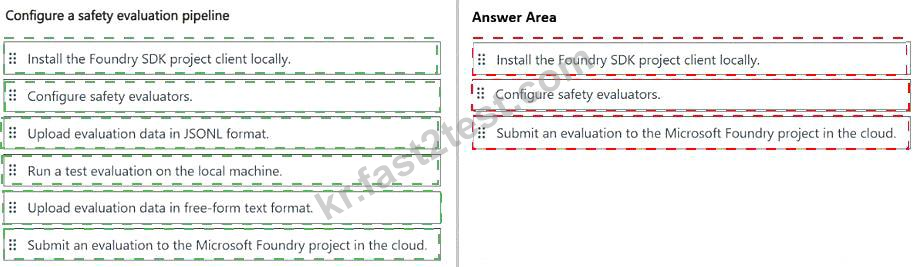
Correct sequence:
* Install the Foundry SDK project client locally.
* Configure safety evaluators.
* Submit an evaluation to the Microsoft Foundry project in the cloud.
The first step is to install and configure the Microsoft Foundry SDK project client . Microsoft documents the Foundry project client as the programmatic entry point for authenticating to a Foundry project and accessing its evaluation capabilities. The client typically uses DefaultAzureCredential, avoiding embedded credentials while enabling access to project resources.
Next, configure the safety evaluators that correspond to the risks that must be measured. Microsoft Foundry provides built-in safety evaluators for categories including Violence, Sexual content, Self-harm, and Hate
/Unfairness . These evaluators analyze generated responses and return structured safety assessments rather than relying on subjective manual review.
Finally, submit the evaluation to the Microsoft Foundry project in the cloud . Current Foundry evaluation workflows define the evaluator configuration, create an evaluation, and start an evaluation run in the project.
Results are persisted in Foundry for comparison, auditing, and CI/CD quality gates.
Uploading evaluation data is unnecessary because the scenario explicitly states that the dataset is already registered . Microsoft documentation specifically instructs users to skip dataset upload when a registered dataset already exists. Free-form text upload is also inappropriate because structured evaluation datasets use supported schemas such as JSONL or CSV.
Study Guide Reference: Implement generative AI quality assurance and observability - Foundry evaluations, safety evaluators, evaluation datasets, cloud evaluation runs, and harmful-content measurement.
A team trains an MLflow model that scores customer churn risk. The model will be consumed by different downstream systems.
One system requests predictions synchronously during customer interactions.
Another system submits files containing millions of records for scheduled scoring.
You need to deploy the model by using managed inference options that match each usage pattern.
Which option should you use for each usage pattern? To answer, select the appropriate options in the answer area. NOTE: Each correct selection is worth one point.
정답:

Explanation:
A system requesting predictions synchronously during customer interactions needs sub-second responses, while a system submitting files with millions of records can tolerate minutes of processing time. For real-time synchronous serving, a Managed Online Endpoint provisions a persistent always-on container behind an HTTPS REST endpoint that returns predictions within milliseconds. For large-batch asynchronous scoring, a Batch Endpoint accepts a data asset input, distributes scoring across a compute cluster, and writes results back to storage. Online endpoints support auto-scaling based on request volume and traffic splitting. Batch endpoints are invoked on-demand or on a schedule, automatically provisioning and de-provisioning compute, keeping costs low for intermittent large jobs. Each deployment type is purpose-built for its usage pattern and should not be swapped.
Microsoft Learn Reference Topic: Deploy and score models with managed online endpoints and batch endpoints - Azure Machine Learning
