
Microsoft Administering Windows Server Hybrid Core Infrastructure - AZ-800무료 덤프문제 풀어보기
Hotspot Question
You have an Azure subscription and a computer named Computer1 that runs Windows 11.
From the Azure portal, you deploy a virtual machine named VM1 that runs Windows Server. You configure VM1 to use the default settings.
You need to ensure that you can connect to VM1 by using PowerShell remoting.
Which cmdlet should you run, and what should you use to run the cmdlet? To answer, select the appropriate options in the answer area.
NOTE: Each correct selection is worth one point.

You have an Azure subscription and a computer named Computer1 that runs Windows 11.
From the Azure portal, you deploy a virtual machine named VM1 that runs Windows Server. You configure VM1 to use the default settings.
You need to ensure that you can connect to VM1 by using PowerShell remoting.
Which cmdlet should you run, and what should you use to run the cmdlet? To answer, select the appropriate options in the answer area.
NOTE: Each correct selection is worth one point.
정답:

Case Study 2 - Contoso, Ltd
Overview
Contoso, Ltd. is a company that has a main office in Seattle and two branch offices in Los Angeles and Montreal.
Existing Environment
AD DS Environment
The network contains an on premises Active Directory Domain Services (AD DS) forest named contoso.com. The forest contains two domains named contoso.com and canada.contoso.com.
The forest contains the domain controllers shown in the following table.

All the domain controllers are global catalog servers.
Server infrastructure
The network contains the servers shown in the following table.

A server named Server4 runs Windows Server and is in a workgroup. Windows Firewall on Server4 uses the private profile.
Server2 hosts three virtual machines named VM1, VM2, and VM3.
VM3 is a file server that stores data in the volumes shown in the following table.

Group Policies
The contoso.com domain has the Group Policies Objects (GPOs) shown in the following table.

Existing Identities
The forest contains the users shown in the following table.

The forest contains the groups shown in the following table.
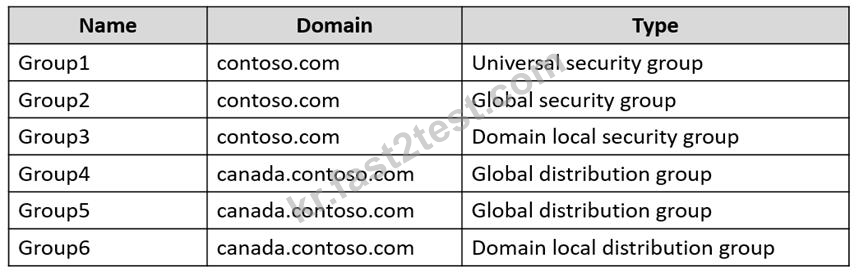
Current Problems
When an administrator signs in to the console of VM2 by using Virtual Machine Connection, and then disconnects from the session without signing out, another administrator can connect to the console session as the currently signed in user.
Requirements
Technical Requirements
Contoso identifies the following technical requirements:
* Change the replication schedule for all site links to 30 minutes.
* Promote Server1 to a domain controller in canada.contoso.com.
* Install and authorize Server3 as a DHCP server.
* Ensure that User1 can manage the membership of all the groups in Contoso\OU3.
* Ensure that you can manage Server4 from Server1 by using PowerShell remoting.
* Ensure that you can run virtual machines on VM1.
* Force users to provide credentials when they connect to VM2.
* On VM3, ensure that Data Deduplication on all volumes is possible.
Question
Hotspot Question
For each of the following statements, select Yes if the statement is true. Otherwise, select No.
NOTE: Each correct selection is worth one point.

Overview
Contoso, Ltd. is a company that has a main office in Seattle and two branch offices in Los Angeles and Montreal.
Existing Environment
AD DS Environment
The network contains an on premises Active Directory Domain Services (AD DS) forest named contoso.com. The forest contains two domains named contoso.com and canada.contoso.com.
The forest contains the domain controllers shown in the following table.
All the domain controllers are global catalog servers.
Server infrastructure
The network contains the servers shown in the following table.
A server named Server4 runs Windows Server and is in a workgroup. Windows Firewall on Server4 uses the private profile.
Server2 hosts three virtual machines named VM1, VM2, and VM3.
VM3 is a file server that stores data in the volumes shown in the following table.
Group Policies
The contoso.com domain has the Group Policies Objects (GPOs) shown in the following table.
Existing Identities
The forest contains the users shown in the following table.
The forest contains the groups shown in the following table.
Current Problems
When an administrator signs in to the console of VM2 by using Virtual Machine Connection, and then disconnects from the session without signing out, another administrator can connect to the console session as the currently signed in user.
Requirements
Technical Requirements
Contoso identifies the following technical requirements:
* Change the replication schedule for all site links to 30 minutes.
* Promote Server1 to a domain controller in canada.contoso.com.
* Install and authorize Server3 as a DHCP server.
* Ensure that User1 can manage the membership of all the groups in Contoso\OU3.
* Ensure that you can manage Server4 from Server1 by using PowerShell remoting.
* Ensure that you can run virtual machines on VM1.
* Force users to provide credentials when they connect to VM2.
* On VM3, ensure that Data Deduplication on all volumes is possible.
Question
Hotspot Question
For each of the following statements, select Yes if the statement is true. Otherwise, select No.
NOTE: Each correct selection is worth one point.
정답:

Explanation:
Box1: No
Admin1 is a domain user, thus only password settings which are applied on DCs will work in this case. From given GPOs only Default Domain Policy are applied on DCs, so minimum passwords length = 10 -> Admin1 does not have to use longer password.
Box2: Yes
User1 is a domain user too so we have same situation as above: minimum passwords length =
10 -> User1 must use a password that has at least 10 characters.
Box3: No
Password settings for local users on Server1 are comming from GPO which is applied to Server1.
Server1 is in OU=Member Servers. OU is linked with GPO2 thus local users on Server1 must use a password that has at least 8 characters.
You have recently joined the company. Nica and you will be responsible for managing Active Directory Domain Services (AD DS) in the administrator role. You need to set the FSMO role such that the Active directory objects will be unique in every domain. Which of the following Flexible Single Master Operation (FSMO) roles is responsible for the uniqueness of Active directory objects in every domain?
정답: E
설명: (Fast2test 회원만 볼 수 있음)
Case Study 3 - ADatum Corporation
Overview
Company Information
ADatum Corporation is a manufacturing company that has a main office in Seattle and two branch offices in Los Angeles and Montreal.
Fabrikam Partnership
ADatum recently partnered with 2 company named Fabrikam, Inc.
Fabrikam is a manufacturing company that has a main office in Boston and a branch office in Orlando.
Both companies intend to collaborate on several joint projects.
Existing Environment
ADatum AD DS Environment
The on-premises network of ADatum contains an Active Directory Domain Services (AD DS) forest named adatum.com.
The forest contains two domains named adatum.com and east.adatum.com and the domain controllers shown in the following table.

Fabrikam AD DS Environment
The on-premises network of Fabrikam contains an AD DS forest named fabrikam.com.
The forest contains two domains named fabrikam.com and south.fabrikam.com.
The fabrikam.com domain contains an organizational unit (OU) named Marketing.
Server Infrastructure
The adatum.com domain contains the servers shown in the following table.

HyperV1 contains the virtual machines shown in the following table.

All the virtual machines on HyperV1 have only the default management tools installed.
SSPace1 contains the Storage Spaces virtual disks shown in the following table.

Azure Resources
ADatum has an Azure subscription that contains an Azure AD tenant. Azure AD Connect is configured to sync the adatum.com forest with Azure AD.
The subscription contains the virtual networks shown in the following table.

The subscription contains the Azure Private DNS zones shown in the following table.

The subscription contains the virtual machines shown in the following table.

All the servers are in a workgroup.
The subscription contains a storage account named storage1 that has a file share named share1.
Requirements
Planned Changes
ADatum plans to implement the following changes:
- Sync Data1 to share1.
- Configure an Azure runbook named Task1.
- Enable Azure AD users to sign in to Server1.
- Create an Azure DNS Private Resolver that has the following configurations:
- Name: Private1
- Region: West US
- Virtual network: VNet1
- Inbound endpoint: SubnetB
- Enable users in the adatum.com domain to access the resources in the south.fabrikam.com domain.
Technical Requirements
ADatum identifies the following technical requirements:
- The data on SSPace1 must be available always.
- DC2 must become the schema master if DC1 fails.
- VM3 must be configured to enable per-folder quotas.
- Trusts must allow access to only the required resources.
- The users in the Marketing OU must have access to storage1.
- Azure Automanage must be used on all supported Azure virtual machines.
- A direct SSH session must be used to manage all the supported virtual machines on HyperV1.
You need to ensure that access to storage1 for the Marketing OU users meets the technical requirements.
What should you implement?
Overview
Company Information
ADatum Corporation is a manufacturing company that has a main office in Seattle and two branch offices in Los Angeles and Montreal.
Fabrikam Partnership
ADatum recently partnered with 2 company named Fabrikam, Inc.
Fabrikam is a manufacturing company that has a main office in Boston and a branch office in Orlando.
Both companies intend to collaborate on several joint projects.
Existing Environment
ADatum AD DS Environment
The on-premises network of ADatum contains an Active Directory Domain Services (AD DS) forest named adatum.com.
The forest contains two domains named adatum.com and east.adatum.com and the domain controllers shown in the following table.
Fabrikam AD DS Environment
The on-premises network of Fabrikam contains an AD DS forest named fabrikam.com.
The forest contains two domains named fabrikam.com and south.fabrikam.com.
The fabrikam.com domain contains an organizational unit (OU) named Marketing.
Server Infrastructure
The adatum.com domain contains the servers shown in the following table.
HyperV1 contains the virtual machines shown in the following table.
All the virtual machines on HyperV1 have only the default management tools installed.
SSPace1 contains the Storage Spaces virtual disks shown in the following table.
Azure Resources
ADatum has an Azure subscription that contains an Azure AD tenant. Azure AD Connect is configured to sync the adatum.com forest with Azure AD.
The subscription contains the virtual networks shown in the following table.
The subscription contains the Azure Private DNS zones shown in the following table.
The subscription contains the virtual machines shown in the following table.
All the servers are in a workgroup.
The subscription contains a storage account named storage1 that has a file share named share1.
Requirements
Planned Changes
ADatum plans to implement the following changes:
- Sync Data1 to share1.
- Configure an Azure runbook named Task1.
- Enable Azure AD users to sign in to Server1.
- Create an Azure DNS Private Resolver that has the following configurations:
- Name: Private1
- Region: West US
- Virtual network: VNet1
- Inbound endpoint: SubnetB
- Enable users in the adatum.com domain to access the resources in the south.fabrikam.com domain.
Technical Requirements
ADatum identifies the following technical requirements:
- The data on SSPace1 must be available always.
- DC2 must become the schema master if DC1 fails.
- VM3 must be configured to enable per-folder quotas.
- Trusts must allow access to only the required resources.
- The users in the Marketing OU must have access to storage1.
- Azure Automanage must be used on all supported Azure virtual machines.
- A direct SSH session must be used to manage all the supported virtual machines on HyperV1.
You need to ensure that access to storage1 for the Marketing OU users meets the technical requirements.
What should you implement?
정답: B
Your network contains an Active Directory Domain Services (AD DS) domain. The domain contains the resources shown in the following table.

You plan to replicate a volume from Server1 to Server2 by using Storage Replica.
You need to configure Storage Replica.
Where should you install Windows Admin Center?
You plan to replicate a volume from Server1 to Server2 by using Storage Replica.
You need to configure Storage Replica.
Where should you install Windows Admin Center?
정답: A
설명: (Fast2test 회원만 볼 수 있음)
You have servers that run Windows Server 2022 as shown in the following table.

Server2 contains a .NET app named App1.
You need to establish a WebSocket connection from App1 to the SQL Server instance on Server1. The solution must meet the following requirements:
- Minimize the number of network ports that must be open on the on-
premises network firewall.
- Minimize administrative effort.
What should you create first?
Server2 contains a .NET app named App1.
You need to establish a WebSocket connection from App1 to the SQL Server instance on Server1. The solution must meet the following requirements:
- Minimize the number of network ports that must be open on the on-
premises network firewall.
- Minimize administrative effort.
What should you create first?
정답: C
설명: (Fast2test 회원만 볼 수 있음)
You have the on-premises apps shown in the following table.

You have a Microsoft Entra tenant.
You plan to deploy Microsoft Entra application proxy.
Which apps will be accessible from the internet by using Application Proxy?
You have a Microsoft Entra tenant.
You plan to deploy Microsoft Entra application proxy.
Which apps will be accessible from the internet by using Application Proxy?
정답: C
설명: (Fast2test 회원만 볼 수 있음)
You have on-premises servers that run Windows Server as shown in the following table.

You have an Azure subscription that contains a virtual machine named VM1.
You need to ensure that you can manage all the servers by using Azure Arc. The solution must minimize administrative effort.
On which servers should you install the Azure Connected Machine agent?
You have an Azure subscription that contains a virtual machine named VM1.
You need to ensure that you can manage all the servers by using Azure Arc. The solution must minimize administrative effort.
On which servers should you install the Azure Connected Machine agent?
정답: B
설명: (Fast2test 회원만 볼 수 있음)
Hotspot Question
You have a server named Server1 that runs Windows Server and is Azure Arc-enabled.
You need to prevent the Microsoft Monitoring Agent from being installed on Server1.
How should you complete the command? To answer, select the appropriate options in the answer area.
NOTE: Each correct selection is worth one point.

You have a server named Server1 that runs Windows Server and is Azure Arc-enabled.
You need to prevent the Microsoft Monitoring Agent from being installed on Server1.
How should you complete the command? To answer, select the appropriate options in the answer area.
NOTE: Each correct selection is worth one point.
정답:

Explanation:
Box 1: azcmagent
azcmagent config set extensions.blocklist
"Microsoft.EnterpriseCloud.Monitoring/MicrosoftMonitoringAgent" is the command used to prevent the Microsoft Monitoring Agent from being installed via VM extensions on an Azure Arc- enabled server.
The Azure Connected Machine Agent (azcmagent) command-line tool provides local security controls to restrict extensions by specifying their Publisher/Type in a comma-separated blocklist.
Box 2: config
Reference:
https://github.com/MicrosoftDocs/azure-management-docs/blob/main/articles/azure-arc/servers/security-extensions.md
Hotspot Question
You have a Windows Server container host named Server1 and an Azure subscription.
You deploy an Azure container registry named Registry1 to the subscription.
On Server1, you create a container image named image1.
You need to store image1 in Registry1.
Which command should you run on Server1? To answer, select the appropriate options in the answer area.
NOTE: Each correct selection is worth one point.

You have a Windows Server container host named Server1 and an Azure subscription.
You deploy an Azure container registry named Registry1 to the subscription.
On Server1, you create a container image named image1.
You need to store image1 in Registry1.
Which command should you run on Server1? To answer, select the appropriate options in the answer area.
NOTE: Each correct selection is worth one point.
정답:

Explanation:
Push the image to your registry
Now that you've tagged the image with the fully qualified path to your private registry, you can push it to the registry with docker push:
docker push myregistry.azurecr.io/samples/nginx
https://learn.microsoft.com/en-us/azure/container-registry/container-registry-get-started-docker-cli?tabs=azure-cli#push-the-image-to-your-registry
Your network contains an Active Directory Domain Services (AD DS) forest. The forest contains three domains. Each domain contains 10 domain controllers.
You plan to store a DNS zone in a custom Active Directory partition.
You need to create the Active Directory partition for the zone. The partition must replicate to only four of the domain controllers.
What should you use?
You plan to store a DNS zone in a custom Active Directory partition.
You need to create the Active Directory partition for the zone. The partition must replicate to only four of the domain controllers.
What should you use?
정답: A
You have a server named Server1 that hosts Windows containers.
You plan to deploy an application that will have multiple containers. Each container will be on the same subnet. Each container requires a separate MAC address and IP address. Each container must be able to communicate by using its IP address.
You need to create a Docker network that supports the deployment of the application.
Which type of network should you create?
You plan to deploy an application that will have multiple containers. Each container will be on the same subnet. Each container requires a separate MAC address and IP address. Each container must be able to communicate by using its IP address.
You need to create a Docker network that supports the deployment of the application.
Which type of network should you create?
정답: C
설명: (Fast2test 회원만 볼 수 있음)
You have an Active Directory Domain Services (AD DS) domain. The domain contains a member server named Server1 that runs Windows Server.
You need to ensure that you can manage password policies for the domain from Server1.
Which command should you run first on Server1?
You need to ensure that you can manage password policies for the domain from Server1.
Which command should you run first on Server1?
정답: A
Hotspot Question
Your network contains an Active Directory Domain Services (AD DS) forest named contoso.com.
You create the resources shown in the following table.

You create the Group Policy Objects (GPOs) shown in the following table.

You configure the Group Policy Preferences shown in the following table.

For each of the following statements, select Yes if the statement is true. Otherwise, select No.
NOTE: Each correct selection is worth one point.

Your network contains an Active Directory Domain Services (AD DS) forest named contoso.com.
You create the resources shown in the following table.
You create the Group Policy Objects (GPOs) shown in the following table.
You configure the Group Policy Preferences shown in the following table.
For each of the following statements, select Yes if the statement is true. Otherwise, select No.
NOTE: Each correct selection is worth one point.
정답:

Explanation:
Box 1: No
User1 is in OU1, and Comp1 is in OU2. GPO2, which applies to OU2, contains the setting for Link4 in the User Configuration. Since User1 is not part of OU2, Link4 will not appear on the desktop.
Box 2: Yes
User2 is part of Group1, which is in OU1, and GPO1 is linked to OU1. GPO1's User Configuration will apply, which includes creating the Link2 shortcut.
Box 3: No
User3 is part of Group1, which is in OU2. GPO2 applies to OU2 and contains settings for Link3 and Link4, not Link2. Therefore, Link2 will not appear on the desktop for User3.