
SOA Cloud Technology Lab - C90.03무료 덤프문제 풀어보기
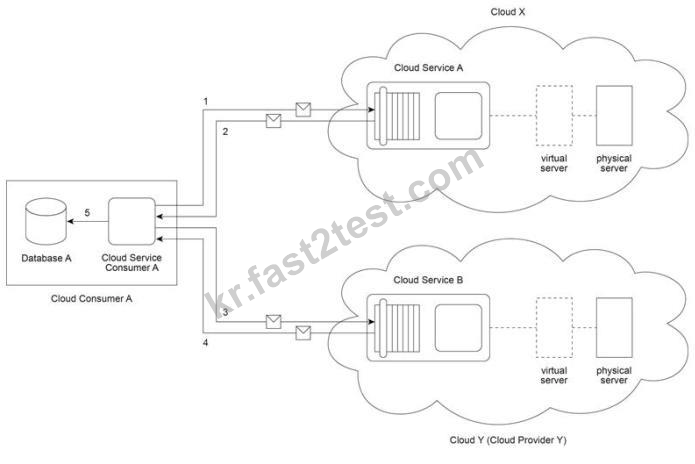
Cloud Service Consumer A accesses Cloud Service A (1) that resides in Cloud X.
a private cloud owned by the same organization acting as Cloud Consumer A.
Cloud Service A
processes the message from Cloud Service Consumer A and then sends back a response
with the requested data (2). Next, Cloud Service Consumer A sends a message containing
some of this data to Cloud Service B (3), which resides in public Cloud Y that is owned by
Cloud Provider Y.
After processing the message. Cloud Service B sends back a response
with additional data to Cloud Service Consumer A (4). Finally, Cloud Service Consumer A
writes the data it collected from Cloud Services A and B to Database A (5).
Recently, Cloud Service Consumer A has been required to access Cloud Services A and B
at a significantly higher rate, sometimes over 1,000 times within a given workday. This
increased usage has not affected Cloud Service B' s performance. Cloud Service A,
however, has been generating runtime exceptions, and responses to Cloud Service
Consumer A have become increasingly slow and unreliable. It is determined that this
decline in performance is due to infrastructure limitations within private Cloud X' s
environment. Instead of investing in new infrastructure for Cloud X, it is decided to explore
the feasibility of moving Cloud Service A to Cloud Y instead.
Which of the following statements describe valid financial considerations that can be taken
into account for assessing the feasibility of this move?
a private cloud owned by the same organization acting as Cloud Consumer A.
Cloud Service A
processes the message from Cloud Service Consumer A and then sends back a response
with the requested data (2). Next, Cloud Service Consumer A sends a message containing
some of this data to Cloud Service B (3), which resides in public Cloud Y that is owned by
Cloud Provider Y.
After processing the message. Cloud Service B sends back a response
with additional data to Cloud Service Consumer A (4). Finally, Cloud Service Consumer A
writes the data it collected from Cloud Services A and B to Database A (5).
Recently, Cloud Service Consumer A has been required to access Cloud Services A and B
at a significantly higher rate, sometimes over 1,000 times within a given workday. This
increased usage has not affected Cloud Service B' s performance. Cloud Service A,
however, has been generating runtime exceptions, and responses to Cloud Service
Consumer A have become increasingly slow and unreliable. It is determined that this
decline in performance is due to infrastructure limitations within private Cloud X' s
environment. Instead of investing in new infrastructure for Cloud X, it is decided to explore
the feasibility of moving Cloud Service A to Cloud Y instead.
Which of the following statements describe valid financial considerations that can be taken
into account for assessing the feasibility of this move?
정답: A,C,D
A company is planning to build and launch a new SaaS product that will be available for
use by the general public. It intends to build the service on-premise and then deploy it in a
public cloud. The company has the following set of four requirements for the
implementation of the new service:
1. The cloud service needs to exchange messages primarily by using HTTP methods and
other features provided by HTTP.
2. The cloud service needs to store highly structured data with potentially complex
relationships.
3. The cloud service needs to be deployed on a dedicated virtual server that can be
administered with a high level of control by the cloud consumer's own cloud resource
administrator.
4. The cloud service needs to be deployed with a minimal amount of integration testing.
For this project, the company has a very limited budget. The company is assessing the IT
resources that are offered by Clouds X and Y within the constraints of its limited budget.
Cloud X can offer an IaaS environment with very few proprietary characteristics that
includes a database that supports only no relational storage, as well as support for the
deployment and usage of REST services.
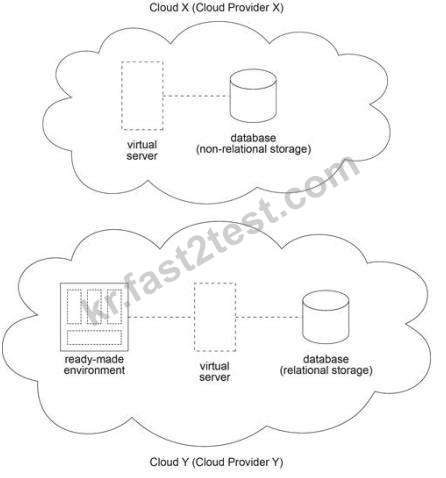
Cloud Y can offer a PaaS environment with a pre-configured virtual server that includes
native support for WSDL and SOAP, as well as a database that supports only relational
storage. The implementation of a new service within Cloud Y will require compliance to a
high level of proprietary characteristics.
As previously listed, the company has identified four specific implementation requirements
for its new cloud service. Which of the following statements correctly identifies how many of
the four requirements Clouds X and Y can directly fulfill?
use by the general public. It intends to build the service on-premise and then deploy it in a
public cloud. The company has the following set of four requirements for the
implementation of the new service:
1. The cloud service needs to exchange messages primarily by using HTTP methods and
other features provided by HTTP.
2. The cloud service needs to store highly structured data with potentially complex
relationships.
3. The cloud service needs to be deployed on a dedicated virtual server that can be
administered with a high level of control by the cloud consumer's own cloud resource
administrator.
4. The cloud service needs to be deployed with a minimal amount of integration testing.
For this project, the company has a very limited budget. The company is assessing the IT
resources that are offered by Clouds X and Y within the constraints of its limited budget.
Cloud X can offer an IaaS environment with very few proprietary characteristics that
includes a database that supports only no relational storage, as well as support for the
deployment and usage of REST services.
Cloud Y can offer a PaaS environment with a pre-configured virtual server that includes
native support for WSDL and SOAP, as well as a database that supports only relational
storage. The implementation of a new service within Cloud Y will require compliance to a
high level of proprietary characteristics.
As previously listed, the company has identified four specific implementation requirements
for its new cloud service. Which of the following statements correctly identifies how many of
the four requirements Clouds X and Y can directly fulfill?
정답: C
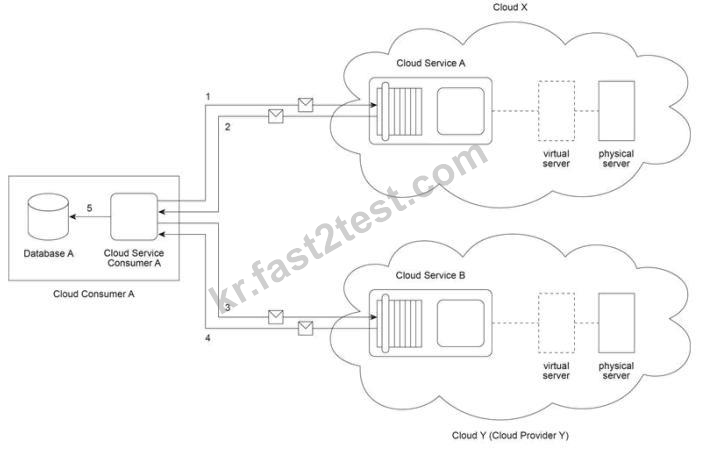
Cloud Service Consumer A accesses Cloud Service A (1) that resides in Cloud X.
a private cloud owned by the same organization acting as Cloud Consumer A.
Cloud Service A processes the message from Cloud Service Consumer A and then sends back a response
with the requested data (2). Next, Cloud Service Consumer A sends a message containing
some of this data to Cloud Service B (3), which resides in public Cloud Y that is owned by
Cloud Provider Y.
After processing the message, Cloud Service B sends back a response
with additional data to Cloud Service Consumer A (4). Finally, Cloud Service Consumer A
writes the data it collected from Cloud Services A and B to Database A (5).
Recently, Cloud Service Consumer A has been required to access Cloud Services A and B
at a significantly higher rate, sometimes over 1,000 times within a given workday. This
increased usage has not affected Cloud Service B's performance. Cloud Service A,
however, has been generating runtime exceptions and responses to Cloud Service
Consumer A have become increasingly slow and unreliable. It is determined that this
decline in performance is due to infrastructure limitations within private Cloud X's
environment. Instead of investing in new infrastructure for Cloud X, it is decided to explore
the feasibility of moving Cloud Service A to Cloud Y instead.
Which of the following statements describe valid financial considerations that can be taken
into account for assessing the feasibility of this move?
a private cloud owned by the same organization acting as Cloud Consumer A.
Cloud Service A processes the message from Cloud Service Consumer A and then sends back a response
with the requested data (2). Next, Cloud Service Consumer A sends a message containing
some of this data to Cloud Service B (3), which resides in public Cloud Y that is owned by
Cloud Provider Y.
After processing the message, Cloud Service B sends back a response
with additional data to Cloud Service Consumer A (4). Finally, Cloud Service Consumer A
writes the data it collected from Cloud Services A and B to Database A (5).
Recently, Cloud Service Consumer A has been required to access Cloud Services A and B
at a significantly higher rate, sometimes over 1,000 times within a given workday. This
increased usage has not affected Cloud Service B's performance. Cloud Service A,
however, has been generating runtime exceptions and responses to Cloud Service
Consumer A have become increasingly slow and unreliable. It is determined that this
decline in performance is due to infrastructure limitations within private Cloud X's
environment. Instead of investing in new infrastructure for Cloud X, it is decided to explore
the feasibility of moving Cloud Service A to Cloud Y instead.
Which of the following statements describe valid financial considerations that can be taken
into account for assessing the feasibility of this move?
정답: A,B