
CIPS Strategic Ethical Leadership - L6M1무료 덤프문제 풀어보기
SIMULATION
Discuss the role that independent organisations in the third sector can play with regards to ethical business practices. Your answer may make reference to one or more of the following: United Nations, Tradecraft UK, Walk Free Foundation, IMF, ILO. (25 points)
Discuss the role that independent organisations in the third sector can play with regards to ethical business practices. Your answer may make reference to one or more of the following: United Nations, Tradecraft UK, Walk Free Foundation, IMF, ILO. (25 points)
정답:
See the Answer is the explanation
Explanation:
Overall explanation
Below you will find how you can plan and draft the essay. Remember this is an example of one way you could approach the question. At Level 6 the questions are much more open so your response may be completely different and that's okay.
Essay Plan
Introduction - what is the 3rd sector?
P1 - role of advocate - promoting ethical business practices
P2 - role of watchdog
P3 - role of researcher - example of UNICEF and Cocoa
P4 - role of influencing global policies e.g. ILO Decent Work Agenda
P5 - Decent Work Agenda - explanation
Conclusion - work of third sector is critical to support advances in ethical business practices Example Essay Independent organizations in the third sector, also known as non-governmental organizations (NGOs) and civil society groups, play a crucial role in promoting ethical business practices on a global scale. This essay explores the multifaceted role of independent organizations in advancing ethical business practices and will focus on the work of the United Nations and the International Labour Organization (ILO).
Independent organizations in the third sector serve as advocates for ethical business practices. They raise awareness about ethical issues, such as fair labour practices, environmental sustainability, and responsible supply chain management. By conducting research, publishing reports, and engaging in public discourse, these organizations bring attention to areas where ethical improvements are needed.
Moreover, independent organizations often act as watchdogs, monitoring the actions of businesses and governments to ensure adherence to ethical standards. They use tools like corporate social responsibility (CSR) evaluations and human rights impact assessments to hold organizations accountable for their practices. For instance, NGOs may investigate and expose cases of labour exploitation or environmental violations in global supply chains.
For example, the International Labour Organization (ILO), a specialized agency of the United Nations, initiated efforts to combat child labour and forced labour in the cocoa industry. Children, often working in hazardous conditions, were involved in harvesting cocoa beans, which raised serious ethical and human rights concerns . The ILO along with UNICEF (United Nations Children's Fund) conducted studies, surveys, and assessments to gather data on child labour and forced labour. This resulted in the creation of the Harkin-Engel Protocol. Under the protocol, the chocolate and cocoa industry committed to taking specific actions to eliminate the worst forms of child labour and forced labour from cocoa production, encouraging businesses to adopt responsible sourcing practices, implement traceability measures, and invest in community development programs. While challenges persist, ILO/ UNICEF's efforts have contributed to significant improvements in labour conditions and a greater emphasis on ethical practices in the cocoa supply chain.
Furthermore, the United Nations, particularly the Economic and Social Council (ECOSOC), provides a platform for independent organizations to engage with governments and international institutions on ethical business practices. ECOSOC consults with NGOs, enabling them to contribute to discussions on sustainable development goals, human rights, and economic policies. This engagement ensures that ethical considerations are integrated into global policymaking.
Another example of how third sector organisations contribute to ethical business practices is the International Labour Organization (ILO) conventions, such as the 2018 Decent Work Agend a. This framework encompasses four main pillars
1) Employment: creating jobs and expanding opportunities for all. The goal is to promote full and productive employment, ensure equal pay for equal work, and reduce informal employment. It also emphasizes the importance of addressing unemployment, underemployment, and vulnerable employment, particularly in developing countries.
2) Social Protection: it highlights the need for comprehensive social protection systems. This includes access to essential health services, maternity protection, unemployment benefits, disability benefits, and pensions. Social protection helps individuals and families cope with various economic and social risks.
3) Social Dialogue: the active participation of workers, employers, and governments in decision-making processes related to labour policies and regulations. Social dialogue is essential for achieving fair and equitable labour practices, including collective bargaining and labour rights.
4) Rights at Work: the right to freedom of association, the right to collective bargaining, the elimination of forced labour and child labour, and the elimination of discrimination in the workplace. Ensuring these rights helps create a fair and just work environment.
The Decent Work Agenda represents a comprehensive and integrated approach to labour and employment issues, aiming to improve the well-being of workers and their families while fostering economic growth and development. It addresses the challenges and opportunities arising from changes in the world of work, such as globalization, technological advancements, and demographic shifts.
In conclusion, independent organizations in the third sector are instrumental in advancing ethical business practices globally. Their roles as advocates, monitors, collaborators, and educators are essential in holding businesses and governments accountable for their actions. Through engagement with institutions like the United Nations and initiatives like the ILO's Decent Work Agenda, these organizations contribute to the promotion of ethical practices in business, fostering a more just and sustainable global economy. Their efforts complement the broader goals of achieving social responsibility, human rights, and environmental sustainability in the business world.
Tutor Notes
- Out of those listed, you could get a lot of content out of the UN and ILO (remember the ILO is part of the UN). These would be my personal choice to pick and learn about because there are lots of examples you could talk about. I chose Cocoa and Child Labour. Other things you could have wrote about include:
- ILO Convention No. 29 (Forced Labour Convention, 1930): This convention requires member states to suppress the use of forced labour in all its forms, including slavery, debt bondage, and forced or compulsory labour.
- ILO Convention No. 105 (Abolition of Forced Labour Convention, 1957): This convention complements Convention No. 29 and aims to abolish forced labour through measures such as effective enforcement of laws and policies.
- Goal 8 of the United Nations Sustainable Development Goals (SDGs) specifically targets decent work and economic growth. Target 8.7 within this goal calls for the "immediate and effective measures to eradicate forced labour, end modern slavery and human trafficking and secure the prohibition and elimination of the worst forms of child labour." The UN promotes the SDGs as a framework for addressing forced labour and related issues.
- The UN provides technical assistance to countries, helping them develop and implement legislation and policies to combat forced labour. This assistance includes capacity building, training, and sharing best practices.
- Tradecraft UK, Walk Free and IMF are also mentioned in the study guide. Here's some info you could have included if you wished to talk about them in your essay:
- Tradecraft = IMPORTANT - as of 2023 this organisation is in Administration. The study guide and exam questions were written before this happened, so may refer to it in the present tense. Your response should mention it in the past tense. Tradecraft was a UK-based Fair Trade Organisation that sold products that were traded fairly in the UK. Their mission was to fight poverty through promoting approaches to trade that will help people in developing countries change their lives. It developed programmes working with poor producers in Africa and Asia. E.g. helped small Indian tea producers negotiate higher prices and get representation on the Tea Board of India. Also helped African Framers negotiate for better PPE and provided training to them so they're more confident to negotiate contract terms such as not allowing late changes to quantities. Traidcraft goes into Administration - One World Shop
- Walk Free Foundation = Aim is to eliminate modern slavery- publishes the Global Slavery Index. They engage in research, advocacy, and awareness-raising activities. Walk Free Foundation Official Website
Explanation:
Overall explanation
Below you will find how you can plan and draft the essay. Remember this is an example of one way you could approach the question. At Level 6 the questions are much more open so your response may be completely different and that's okay.
Essay Plan
Introduction - what is the 3rd sector?
P1 - role of advocate - promoting ethical business practices
P2 - role of watchdog
P3 - role of researcher - example of UNICEF and Cocoa
P4 - role of influencing global policies e.g. ILO Decent Work Agenda
P5 - Decent Work Agenda - explanation
Conclusion - work of third sector is critical to support advances in ethical business practices Example Essay Independent organizations in the third sector, also known as non-governmental organizations (NGOs) and civil society groups, play a crucial role in promoting ethical business practices on a global scale. This essay explores the multifaceted role of independent organizations in advancing ethical business practices and will focus on the work of the United Nations and the International Labour Organization (ILO).
Independent organizations in the third sector serve as advocates for ethical business practices. They raise awareness about ethical issues, such as fair labour practices, environmental sustainability, and responsible supply chain management. By conducting research, publishing reports, and engaging in public discourse, these organizations bring attention to areas where ethical improvements are needed.
Moreover, independent organizations often act as watchdogs, monitoring the actions of businesses and governments to ensure adherence to ethical standards. They use tools like corporate social responsibility (CSR) evaluations and human rights impact assessments to hold organizations accountable for their practices. For instance, NGOs may investigate and expose cases of labour exploitation or environmental violations in global supply chains.
For example, the International Labour Organization (ILO), a specialized agency of the United Nations, initiated efforts to combat child labour and forced labour in the cocoa industry. Children, often working in hazardous conditions, were involved in harvesting cocoa beans, which raised serious ethical and human rights concerns . The ILO along with UNICEF (United Nations Children's Fund) conducted studies, surveys, and assessments to gather data on child labour and forced labour. This resulted in the creation of the Harkin-Engel Protocol. Under the protocol, the chocolate and cocoa industry committed to taking specific actions to eliminate the worst forms of child labour and forced labour from cocoa production, encouraging businesses to adopt responsible sourcing practices, implement traceability measures, and invest in community development programs. While challenges persist, ILO/ UNICEF's efforts have contributed to significant improvements in labour conditions and a greater emphasis on ethical practices in the cocoa supply chain.
Furthermore, the United Nations, particularly the Economic and Social Council (ECOSOC), provides a platform for independent organizations to engage with governments and international institutions on ethical business practices. ECOSOC consults with NGOs, enabling them to contribute to discussions on sustainable development goals, human rights, and economic policies. This engagement ensures that ethical considerations are integrated into global policymaking.
Another example of how third sector organisations contribute to ethical business practices is the International Labour Organization (ILO) conventions, such as the 2018 Decent Work Agend a. This framework encompasses four main pillars
1) Employment: creating jobs and expanding opportunities for all. The goal is to promote full and productive employment, ensure equal pay for equal work, and reduce informal employment. It also emphasizes the importance of addressing unemployment, underemployment, and vulnerable employment, particularly in developing countries.
2) Social Protection: it highlights the need for comprehensive social protection systems. This includes access to essential health services, maternity protection, unemployment benefits, disability benefits, and pensions. Social protection helps individuals and families cope with various economic and social risks.
3) Social Dialogue: the active participation of workers, employers, and governments in decision-making processes related to labour policies and regulations. Social dialogue is essential for achieving fair and equitable labour practices, including collective bargaining and labour rights.
4) Rights at Work: the right to freedom of association, the right to collective bargaining, the elimination of forced labour and child labour, and the elimination of discrimination in the workplace. Ensuring these rights helps create a fair and just work environment.
The Decent Work Agenda represents a comprehensive and integrated approach to labour and employment issues, aiming to improve the well-being of workers and their families while fostering economic growth and development. It addresses the challenges and opportunities arising from changes in the world of work, such as globalization, technological advancements, and demographic shifts.
In conclusion, independent organizations in the third sector are instrumental in advancing ethical business practices globally. Their roles as advocates, monitors, collaborators, and educators are essential in holding businesses and governments accountable for their actions. Through engagement with institutions like the United Nations and initiatives like the ILO's Decent Work Agenda, these organizations contribute to the promotion of ethical practices in business, fostering a more just and sustainable global economy. Their efforts complement the broader goals of achieving social responsibility, human rights, and environmental sustainability in the business world.
Tutor Notes
- Out of those listed, you could get a lot of content out of the UN and ILO (remember the ILO is part of the UN). These would be my personal choice to pick and learn about because there are lots of examples you could talk about. I chose Cocoa and Child Labour. Other things you could have wrote about include:
- ILO Convention No. 29 (Forced Labour Convention, 1930): This convention requires member states to suppress the use of forced labour in all its forms, including slavery, debt bondage, and forced or compulsory labour.
- ILO Convention No. 105 (Abolition of Forced Labour Convention, 1957): This convention complements Convention No. 29 and aims to abolish forced labour through measures such as effective enforcement of laws and policies.
- Goal 8 of the United Nations Sustainable Development Goals (SDGs) specifically targets decent work and economic growth. Target 8.7 within this goal calls for the "immediate and effective measures to eradicate forced labour, end modern slavery and human trafficking and secure the prohibition and elimination of the worst forms of child labour." The UN promotes the SDGs as a framework for addressing forced labour and related issues.
- The UN provides technical assistance to countries, helping them develop and implement legislation and policies to combat forced labour. This assistance includes capacity building, training, and sharing best practices.
- Tradecraft UK, Walk Free and IMF are also mentioned in the study guide. Here's some info you could have included if you wished to talk about them in your essay:
- Tradecraft = IMPORTANT - as of 2023 this organisation is in Administration. The study guide and exam questions were written before this happened, so may refer to it in the present tense. Your response should mention it in the past tense. Tradecraft was a UK-based Fair Trade Organisation that sold products that were traded fairly in the UK. Their mission was to fight poverty through promoting approaches to trade that will help people in developing countries change their lives. It developed programmes working with poor producers in Africa and Asia. E.g. helped small Indian tea producers negotiate higher prices and get representation on the Tea Board of India. Also helped African Framers negotiate for better PPE and provided training to them so they're more confident to negotiate contract terms such as not allowing late changes to quantities. Traidcraft goes into Administration - One World Shop
- Walk Free Foundation = Aim is to eliminate modern slavery- publishes the Global Slavery Index. They engage in research, advocacy, and awareness-raising activities. Walk Free Foundation Official Website
SIMULATION
Mark is the Head of IT at Squirrel Incorporated and has been asked to join a cross-functional team including staff from the procurement and finance departments. The team is tasked with looking into the procurement of a new IT system. Explain some of the different roles that Mark could play in this newly formed team and discuss how Mark can influence the outcome of decisions made. (25 points)
Mark is the Head of IT at Squirrel Incorporated and has been asked to join a cross-functional team including staff from the procurement and finance departments. The team is tasked with looking into the procurement of a new IT system. Explain some of the different roles that Mark could play in this newly formed team and discuss how Mark can influence the outcome of decisions made. (25 points)
정답:
See the Answer is the explanation
Explanation:
Mark's Role and Influence in a Cross-Functional Procurement Team
As Head of IT at Squirrel Incorporated, Mark has been asked to join a cross-functional team to evaluate and procure a new IT system. This team includes representatives from procurement and finance, meaning each member will have a distinct perspective. Given Mark's technical expertise, he can play multiple roles in the decision-making process. This essay explores key roles Mark could play and how he can influence the outcome of decisions.
Roles Mark Could Play in the Team
1. Technical Expert
Since the procurement involves an IT system, Mark's primary role is to provide technical expertise on system requirements, compatibility, and security.
Responsibilities:
Define the technical specifications for the new system.
Ensure the system is compatible with existing infrastructure.
Evaluate vendors' technical capabilities and cybersecurity compliance.
Influence on Outcome:
✔ Ensures only technically viable solutions are considered.
✔ Prevents the company from investing in obsolete or incompatible technology.
2. Liaison Between IT and Other Departments
Since procurement and finance teams may not have deep technical knowledge, Mark can act as a translator, ensuring IT needs are understood and integrated into procurement decisions.
Responsibilities:
Explain technical jargon in business-friendly terms.
Align IT system selection with business objectives.
Address concerns from finance (budget) and procurement (supplier contracts).
Influence on Outcome:
✔ Ensures the new system meets business and IT needs.
✔ Helps non-technical team members make informed decisions.
3. Risk Assessor
IT systems carry risks related to cybersecurity, compliance, and implementation challenges. Mark can lead in risk assessment and mitigation.
Responsibilities:
Identify potential security vulnerabilities.
Ensure compliance with data protection laws (e.g., GDPR, CCPA).
Evaluate risks related to system downtime and integration failures.
Influence on Outcome:
✔ Reduces the risk of costly data breaches or compliance violations.
✔ Helps select vendors with strong security measures.
4. Change Management Facilitator
Implementing a new IT system requires user training and adaptation. Mark can anticipate resistance to change and help ensure smooth adoption.
Responsibilities:
Assess potential user resistance and develop a training plan.
Work with HR and department heads to facilitate smooth transition.
Provide input on user experience (UX) and ease of use.
Influence on Outcome:
✔ Increases the likelihood of successful system adoption.
✔ Reduces productivity losses due to poor training or resistance.
5. Budget and Cost Advisor
Although finance oversees budget approvals, Mark can help justify IT-related expenses and ensure the team gets the best value for the investment.
Responsibilities:
Identify hidden costs (e.g., licensing fees, maintenance, upgrades).
Compare on-premise vs. cloud-based solutions for cost-effectiveness.
Negotiate with vendors for best pricing and support packages.
Influence on Outcome:
✔ Ensures long-term cost savings by choosing a scalable, efficient system.
✔ Prevents overspending on unnecessary features.
How Mark Can Influence Decision-Making
Mark's technical knowledge, risk assessment skills, and financial awareness give him significant influence over the team's decisions. Here's how he can maximize his impact:
Providing Data-Driven Insights
Use comparative analysis to show which IT system performs best.
Present case studies or industry benchmarks to support recommendations.
Building Consensus Among Team Members
Address concerns of procurement (vendor selection) and finance (cost control).
Act as a neutral party balancing IT needs with business constraints.
Advocating for Long-Term Strategy Over Short-Term Cost Savings
Highlight scalability and future-proofing rather than just upfront costs.
Explain the total cost of ownership (TCO), including maintenance and upgrades.
Engaging with Vendors and Negotiating Best Terms
Participate in vendor meetings to ensure IT concerns are properly addressed.
Suggest contractual terms that provide flexibility and service guarantees.
Conclusion
Mark's role in this cross-functional team is critical to ensuring a successful IT system procurement. By acting as a technical expert, liaison, risk assessor, change manager, and budget advisor, he can ensure that business needs, security, and cost-effectiveness are balanced. His ability to communicate effectively, present data-driven insights, and align stakeholders will significantly influence the final decision. Through strategic engagement, Mark can help the team select the best IT system that supports Squirrel Incorporated's long-term success.
Explanation:
Mark's Role and Influence in a Cross-Functional Procurement Team
As Head of IT at Squirrel Incorporated, Mark has been asked to join a cross-functional team to evaluate and procure a new IT system. This team includes representatives from procurement and finance, meaning each member will have a distinct perspective. Given Mark's technical expertise, he can play multiple roles in the decision-making process. This essay explores key roles Mark could play and how he can influence the outcome of decisions.
Roles Mark Could Play in the Team
1. Technical Expert
Since the procurement involves an IT system, Mark's primary role is to provide technical expertise on system requirements, compatibility, and security.
Responsibilities:
Define the technical specifications for the new system.
Ensure the system is compatible with existing infrastructure.
Evaluate vendors' technical capabilities and cybersecurity compliance.
Influence on Outcome:
✔ Ensures only technically viable solutions are considered.
✔ Prevents the company from investing in obsolete or incompatible technology.
2. Liaison Between IT and Other Departments
Since procurement and finance teams may not have deep technical knowledge, Mark can act as a translator, ensuring IT needs are understood and integrated into procurement decisions.
Responsibilities:
Explain technical jargon in business-friendly terms.
Align IT system selection with business objectives.
Address concerns from finance (budget) and procurement (supplier contracts).
Influence on Outcome:
✔ Ensures the new system meets business and IT needs.
✔ Helps non-technical team members make informed decisions.
3. Risk Assessor
IT systems carry risks related to cybersecurity, compliance, and implementation challenges. Mark can lead in risk assessment and mitigation.
Responsibilities:
Identify potential security vulnerabilities.
Ensure compliance with data protection laws (e.g., GDPR, CCPA).
Evaluate risks related to system downtime and integration failures.
Influence on Outcome:
✔ Reduces the risk of costly data breaches or compliance violations.
✔ Helps select vendors with strong security measures.
4. Change Management Facilitator
Implementing a new IT system requires user training and adaptation. Mark can anticipate resistance to change and help ensure smooth adoption.
Responsibilities:
Assess potential user resistance and develop a training plan.
Work with HR and department heads to facilitate smooth transition.
Provide input on user experience (UX) and ease of use.
Influence on Outcome:
✔ Increases the likelihood of successful system adoption.
✔ Reduces productivity losses due to poor training or resistance.
5. Budget and Cost Advisor
Although finance oversees budget approvals, Mark can help justify IT-related expenses and ensure the team gets the best value for the investment.
Responsibilities:
Identify hidden costs (e.g., licensing fees, maintenance, upgrades).
Compare on-premise vs. cloud-based solutions for cost-effectiveness.
Negotiate with vendors for best pricing and support packages.
Influence on Outcome:
✔ Ensures long-term cost savings by choosing a scalable, efficient system.
✔ Prevents overspending on unnecessary features.
How Mark Can Influence Decision-Making
Mark's technical knowledge, risk assessment skills, and financial awareness give him significant influence over the team's decisions. Here's how he can maximize his impact:
Providing Data-Driven Insights
Use comparative analysis to show which IT system performs best.
Present case studies or industry benchmarks to support recommendations.
Building Consensus Among Team Members
Address concerns of procurement (vendor selection) and finance (cost control).
Act as a neutral party balancing IT needs with business constraints.
Advocating for Long-Term Strategy Over Short-Term Cost Savings
Highlight scalability and future-proofing rather than just upfront costs.
Explain the total cost of ownership (TCO), including maintenance and upgrades.
Engaging with Vendors and Negotiating Best Terms
Participate in vendor meetings to ensure IT concerns are properly addressed.
Suggest contractual terms that provide flexibility and service guarantees.
Conclusion
Mark's role in this cross-functional team is critical to ensuring a successful IT system procurement. By acting as a technical expert, liaison, risk assessor, change manager, and budget advisor, he can ensure that business needs, security, and cost-effectiveness are balanced. His ability to communicate effectively, present data-driven insights, and align stakeholders will significantly influence the final decision. Through strategic engagement, Mark can help the team select the best IT system that supports Squirrel Incorporated's long-term success.
SIMULATION
Discuss transformational and transactional approaches to leadership. Which is the most appropriate approach in the following case study:
Mo is a procurement manager at a large manufacturing organisation. He oversees a team of 5 procurement assistants. The assistants are currently not working to a high level; they lack skills and confidence in completing tenders and Mo is concerned about their abilities to conduct accurate work. (25 points)
Discuss transformational and transactional approaches to leadership. Which is the most appropriate approach in the following case study:
Mo is a procurement manager at a large manufacturing organisation. He oversees a team of 5 procurement assistants. The assistants are currently not working to a high level; they lack skills and confidence in completing tenders and Mo is concerned about their abilities to conduct accurate work. (25 points)
정답:
See the Answer is the explanation
Explanation:
Introduction
Leadership is a critical factor in shaping employee performance, motivation, and overall organizational success. In procurement, managers must adopt a leadership style that aligns with their team's capabilities, business objectives, and operational challenges. Two widely recognized leadership styles are Transformational Leadership and Transactional Leadership, each with distinct characteristics and effects on team performance.
This essay will discuss both leadership styles, outlining their advantages and disadvantages. It will then evaluate which approach is best suited for Mo, a procurement manager facing skill and confidence issues among his team members.
Understanding Transformational Leadership
Definition
Transformational leadership is a leadership style that focuses on inspiring, motivating, and developing employees to reach their full potential. Transformational leaders act as mentors and role models, encouraging innovation, professional growth, and long-term performance improvements.
Key Characteristics of Transformational Leadership
Inspiration and Motivation - The leader encourages employees to perform beyond expectations through a compelling vision.
Individualized Support - Focuses on mentoring and coaching employees to enhance their skills.
Encourages Innovation - Employees are empowered to think creatively and solve problems.
Develops Future Leaders - Focuses on long-term talent development rather than short-term task completion.
High Engagement and Emotional Intelligence - Builds strong relationships with employees and fosters a positive workplace culture.
Advantages of Transformational Leadership
✅ Encourages professional growth - Employees develop new skills and gain confidence.
✅ Increases motivation and job satisfaction - Employees feel valued and supported.
✅ Promotes innovation and continuous improvement - Encourages employees to think creatively.
✅ Builds long-term organizational success - Creates future leaders through mentoring and skill development.
Disadvantages of Transformational Leadership
❌ Time-consuming - Requires significant time and effort for mentoring and development.
❌ Not suitable for urgent performance issues - If immediate performance improvement is needed, transformational leadership may be too slow.
❌ Employees may resist change - Some employees may be unwilling to embrace coaching and new expectations.
Understanding Transactional Leadership
Definition
Transactional leadership is a leadership style based on a structured, performance-driven approach. It focuses on clear expectations, rewards for success, and consequences for underperformance. This style is best suited for improving task efficiency, enforcing compliance, and ensuring consistency.
Key Characteristics of Transactional Leadership
Clear Expectations and Rules - Employees have defined roles and responsibilities.
Performance-Based Rewards and Punishments - Good performance is rewarded, while poor performance is corrected through disciplinary actions.
Focus on Efficiency and Results - Emphasizes productivity and operational efficiency over employee growth.
Short-Term Performance Goals - Ensures immediate improvements in employee performance.
Hierarchy and Structure - Follows a strict chain of command.
Advantages of Transactional Leadership
✅ Ensures short-term efficiency and compliance - Clearly defines expectations, which leads to immediate improvements in performance.
✅ Effective for structured tasks - Employees know exactly what is expected, reducing uncertainty.
✅ Increases accountability - Employees are held responsible for meeting targets.
✅ Useful for crisis management - Provides a clear directive in high-pressure situations.
Disadvantages of Transactional Leadership
❌ Limited employee development - Focuses more on task completion rather than skill enhancement.
❌ Can reduce creativity and innovation - Employees may feel restricted by rigid expectations.
❌ May reduce motivation - Over-reliance on rules and punishments can create a negative work environment.
❌ Not ideal for building long-term talent - Employees may not develop leadership skills or confidence.
Which Leadership Style is Most Suitable for Mo?
Case Study Analysis: Mo's Leadership Challenge
Mo is a procurement manager leading a team of 5 procurement assistants.
The assistants are underperforming due to lack of skills and confidence.
Mo is concerned about their ability to complete procurement tenders accurately.
Evaluating the Best Leadership Approach for Mo
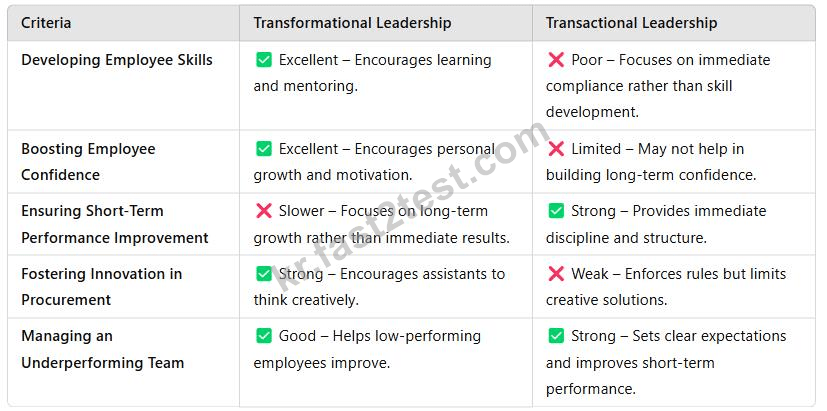
Based on the specific challenges Mo is facing, neither leadership style alone is perfect. Instead, a combined approach is most suitable:
Recommended Approach: A Blend of Transformational and Transactional Leadership Short-Term Approach: Transactional Leadership for Immediate Performance Improvement Mo should set clear expectations and enforce accountability to ensure the assistants improve their performance in procurement tenders.
Implement a structured training program with performance benchmarks.
Use performance-based incentives (e.g., bonuses, recognition for accurate work).
Provide constructive feedback on mistakes to encourage learning.
Long-Term Approach: Transformational Leadership for Skill Development and Confidence Mo should act as a mentor and coach, providing continuous learning opportunities.
Encourage assistants to develop confidence in procurement by assigning them progressively challenging tasks.
Inspire the team by highlighting the importance of procurement excellence in achieving organizational goals.
Implement peer learning and mentorship programs to create a supportive learning environment.
Conclusion
Both Transformational Leadership and Transactional Leadership offer valuable benefits, but in the case of Mo's underperforming team, a blended approach is the most effective strategy.
Transactional Leadership should be used in the short term to improve immediate performance, enforce accountability, and ensure accuracy in procurement tenders.
Transformational Leadership should be introduced gradually to develop skills, boost confidence, and foster long-term career growth among the procurement assistants.
By combining both approaches, Mo can quickly improve his team's performance while ensuring they gain the necessary skills and confidence to succeed in procurement. This balanced leadership approach ensures short-term efficiency and long-term growth, making it the most effective strategy for Mo's situation.
Explanation:
Introduction
Leadership is a critical factor in shaping employee performance, motivation, and overall organizational success. In procurement, managers must adopt a leadership style that aligns with their team's capabilities, business objectives, and operational challenges. Two widely recognized leadership styles are Transformational Leadership and Transactional Leadership, each with distinct characteristics and effects on team performance.
This essay will discuss both leadership styles, outlining their advantages and disadvantages. It will then evaluate which approach is best suited for Mo, a procurement manager facing skill and confidence issues among his team members.
Understanding Transformational Leadership
Definition
Transformational leadership is a leadership style that focuses on inspiring, motivating, and developing employees to reach their full potential. Transformational leaders act as mentors and role models, encouraging innovation, professional growth, and long-term performance improvements.
Key Characteristics of Transformational Leadership
Inspiration and Motivation - The leader encourages employees to perform beyond expectations through a compelling vision.
Individualized Support - Focuses on mentoring and coaching employees to enhance their skills.
Encourages Innovation - Employees are empowered to think creatively and solve problems.
Develops Future Leaders - Focuses on long-term talent development rather than short-term task completion.
High Engagement and Emotional Intelligence - Builds strong relationships with employees and fosters a positive workplace culture.
Advantages of Transformational Leadership
✅ Encourages professional growth - Employees develop new skills and gain confidence.
✅ Increases motivation and job satisfaction - Employees feel valued and supported.
✅ Promotes innovation and continuous improvement - Encourages employees to think creatively.
✅ Builds long-term organizational success - Creates future leaders through mentoring and skill development.
Disadvantages of Transformational Leadership
❌ Time-consuming - Requires significant time and effort for mentoring and development.
❌ Not suitable for urgent performance issues - If immediate performance improvement is needed, transformational leadership may be too slow.
❌ Employees may resist change - Some employees may be unwilling to embrace coaching and new expectations.
Understanding Transactional Leadership
Definition
Transactional leadership is a leadership style based on a structured, performance-driven approach. It focuses on clear expectations, rewards for success, and consequences for underperformance. This style is best suited for improving task efficiency, enforcing compliance, and ensuring consistency.
Key Characteristics of Transactional Leadership
Clear Expectations and Rules - Employees have defined roles and responsibilities.
Performance-Based Rewards and Punishments - Good performance is rewarded, while poor performance is corrected through disciplinary actions.
Focus on Efficiency and Results - Emphasizes productivity and operational efficiency over employee growth.
Short-Term Performance Goals - Ensures immediate improvements in employee performance.
Hierarchy and Structure - Follows a strict chain of command.
Advantages of Transactional Leadership
✅ Ensures short-term efficiency and compliance - Clearly defines expectations, which leads to immediate improvements in performance.
✅ Effective for structured tasks - Employees know exactly what is expected, reducing uncertainty.
✅ Increases accountability - Employees are held responsible for meeting targets.
✅ Useful for crisis management - Provides a clear directive in high-pressure situations.
Disadvantages of Transactional Leadership
❌ Limited employee development - Focuses more on task completion rather than skill enhancement.
❌ Can reduce creativity and innovation - Employees may feel restricted by rigid expectations.
❌ May reduce motivation - Over-reliance on rules and punishments can create a negative work environment.
❌ Not ideal for building long-term talent - Employees may not develop leadership skills or confidence.
Which Leadership Style is Most Suitable for Mo?
Case Study Analysis: Mo's Leadership Challenge
Mo is a procurement manager leading a team of 5 procurement assistants.
The assistants are underperforming due to lack of skills and confidence.
Mo is concerned about their ability to complete procurement tenders accurately.
Evaluating the Best Leadership Approach for Mo
Based on the specific challenges Mo is facing, neither leadership style alone is perfect. Instead, a combined approach is most suitable:
Recommended Approach: A Blend of Transformational and Transactional Leadership Short-Term Approach: Transactional Leadership for Immediate Performance Improvement Mo should set clear expectations and enforce accountability to ensure the assistants improve their performance in procurement tenders.
Implement a structured training program with performance benchmarks.
Use performance-based incentives (e.g., bonuses, recognition for accurate work).
Provide constructive feedback on mistakes to encourage learning.
Long-Term Approach: Transformational Leadership for Skill Development and Confidence Mo should act as a mentor and coach, providing continuous learning opportunities.
Encourage assistants to develop confidence in procurement by assigning them progressively challenging tasks.
Inspire the team by highlighting the importance of procurement excellence in achieving organizational goals.
Implement peer learning and mentorship programs to create a supportive learning environment.
Conclusion
Both Transformational Leadership and Transactional Leadership offer valuable benefits, but in the case of Mo's underperforming team, a blended approach is the most effective strategy.
Transactional Leadership should be used in the short term to improve immediate performance, enforce accountability, and ensure accuracy in procurement tenders.
Transformational Leadership should be introduced gradually to develop skills, boost confidence, and foster long-term career growth among the procurement assistants.
By combining both approaches, Mo can quickly improve his team's performance while ensuring they gain the necessary skills and confidence to succeed in procurement. This balanced leadership approach ensures short-term efficiency and long-term growth, making it the most effective strategy for Mo's situation.
SIMULATION
Jeff is the CEO of Company X. Company X will soon be merging with Company Y. This is a strategic decision which will benefit both companies through sharing knowledge and resources. There will be no job losses in the process of the merger, but there will be significant changes to staffing structures and operating procedures. Jeff needs to communicate the information to stakeholders. Discuss how Jeff could create a Communication Plan to disseminate the information and what considerations he needs to make when passing on the information (25 points)
Jeff is the CEO of Company X. Company X will soon be merging with Company Y. This is a strategic decision which will benefit both companies through sharing knowledge and resources. There will be no job losses in the process of the merger, but there will be significant changes to staffing structures and operating procedures. Jeff needs to communicate the information to stakeholders. Discuss how Jeff could create a Communication Plan to disseminate the information and what considerations he needs to make when passing on the information (25 points)
정답:
See the Answer is the explanation
Explanation:
Developing a Communication Plan for a Company Merger
As CEO of Company X, Jeff is responsible for communicating the upcoming merger with Company Y. While the merger will bring strategic benefits, it will also introduce significant changes to staffing structures and operations. Clear, transparent, and effective communication is crucial to ensure stakeholder confidence, minimize resistance, and facilitate a smooth transition.
This essay outlines how Jeff can develop a Communication Plan and highlights key considerations for delivering the message effectively.
1. Creating a Communication Plan for the Merger
A structured communication plan helps ensure that stakeholders receive the right information, at the right time, through the right channels. Below are the key steps Jeff should take:
Step 1: Define Communication Objectives
Jeff must first establish clear objectives for the communication plan: ✔ Ensure stakeholders understand the benefits and impact of the merger.
✔ Prevent misinformation or panic among employees.
✔ Encourage buy-in and trust from all parties.
✔ Provide a transparent timeline for the changes.
Step 2: Identify Key Stakeholders
Different stakeholders will require different levels of detail and messaging:
Internal Stakeholders:
Employees (most affected by changes in structure and operations).
Management & Leadership Teams (responsible for implementing the merger).
Unions/Employee Representatives (may raise concerns about changes in working conditions).
External Stakeholders:
Customers & Clients (reassurance about continuity of service).
Suppliers & Partners (clarity on future contracts and relationships).
Investors & Shareholders (understanding of financial and strategic benefits).
Each stakeholder group will need tailored messaging to address their specific concerns.
Step 3: Develop Key Messages
Jeff needs to craft clear, consistent, and positive messages tailored to each audience.
Stakeholder
Key Message
Employees
"No job losses; new structure will create growth opportunities."
Managers
"Support will be provided for leadership transition and operational changes." Customers
"Service quality and reliability will remain unchanged."
Investors
"The merger will drive efficiency and profitability."
Suppliers
"Partnerships will continue, and payment terms remain stable."
Jeff should address potential concerns upfront and focus on the benefits of the merger.
Step 4: Select Communication Channels
The choice of communication channels depends on the audience and message urgency.
Stakeholder
Communication Method
Employees
Town hall meetings, emails, intranet updates, one-on-one discussions
Managers
Workshops, leadership meetings, direct emails
Customers
Official press releases, emails, website FAQs
Investors
Investor presentations, reports, media briefings
Suppliers
Supplier meetings, contracts review sessions
Jeff should prioritize face-to-face communication for employees and managers to build trust and allow for direct Q&A sessions.
Step 5: Create a Timeline for Communication
Jeff must ensure timely and consistent updates to avoid uncertainty.
Timeline
Action
Week 1
Announce merger to executives and key managers.
Week 2
Host town hall meetings for employees and issue internal memos.
Week 3
Public announcement via press release and website update.
Week 4
Hold customer and supplier briefings to address concerns.
Ongoing
Provide progress updates through internal and external reports.
Regular updates will help maintain transparency and engagement.
2. Key Considerations for Effective Communication
Jeff must consider several critical factors when passing on the information:
1. Clarity and Transparency
Messages should be clear, honest, and direct to prevent misunderstandings.
Employees should be fully informed about changes before rumors spread.
Example: Instead of vague statements like "There will be some adjustments," Jeff should say, "There will be structural changes, but no job losses."
2. Managing Emotional Reactions
Even without job losses, employees may fear uncertainty about roles and responsibilities.
Jeff should show empathy and reassurance while addressing concerns.
Strategy: Use small group meetings to provide space for open dialogue.
3. Two-Way Communication
Employees and stakeholders should have the opportunity to ask questions and share feedback.
Jeff can set up: ✔ Q&A sessions in town halls.
✔ Anonymous feedback mechanisms for employees hesitant to speak up.
✔ Dedicated email or helpline for merger-related concerns.
4. Aligning with Organizational Values
The messaging should reinforce Company X's culture and mission.
Example: If Company X values innovation, Jeff should highlight how the merger will enhance technological capabilities.
5. Handling Misinformation
Mergers can generate rumors and speculation.
Jeff should appoint a dedicated communication team to: ✔ Monitor and correct misinformation.
✔ Ensure consistent messaging across all departments.
Conclusion
A strategic communication plan is essential for Jeff to successfully manage the merger announcement. By defining objectives, identifying stakeholders, crafting key messages, selecting appropriate channels, and planning a timeline, he can ensure clarity, transparency, and engagement. Considerations such as employee emotions, two-way communication, and misinformation management will help maintain trust and confidence among all stakeholders. With effective communication, Jeff can drive a smooth transition and create a unified, forward-looking organization.
Explanation:
Developing a Communication Plan for a Company Merger
As CEO of Company X, Jeff is responsible for communicating the upcoming merger with Company Y. While the merger will bring strategic benefits, it will also introduce significant changes to staffing structures and operations. Clear, transparent, and effective communication is crucial to ensure stakeholder confidence, minimize resistance, and facilitate a smooth transition.
This essay outlines how Jeff can develop a Communication Plan and highlights key considerations for delivering the message effectively.
1. Creating a Communication Plan for the Merger
A structured communication plan helps ensure that stakeholders receive the right information, at the right time, through the right channels. Below are the key steps Jeff should take:
Step 1: Define Communication Objectives
Jeff must first establish clear objectives for the communication plan: ✔ Ensure stakeholders understand the benefits and impact of the merger.
✔ Prevent misinformation or panic among employees.
✔ Encourage buy-in and trust from all parties.
✔ Provide a transparent timeline for the changes.
Step 2: Identify Key Stakeholders
Different stakeholders will require different levels of detail and messaging:
Internal Stakeholders:
Employees (most affected by changes in structure and operations).
Management & Leadership Teams (responsible for implementing the merger).
Unions/Employee Representatives (may raise concerns about changes in working conditions).
External Stakeholders:
Customers & Clients (reassurance about continuity of service).
Suppliers & Partners (clarity on future contracts and relationships).
Investors & Shareholders (understanding of financial and strategic benefits).
Each stakeholder group will need tailored messaging to address their specific concerns.
Step 3: Develop Key Messages
Jeff needs to craft clear, consistent, and positive messages tailored to each audience.
Stakeholder
Key Message
Employees
"No job losses; new structure will create growth opportunities."
Managers
"Support will be provided for leadership transition and operational changes." Customers
"Service quality and reliability will remain unchanged."
Investors
"The merger will drive efficiency and profitability."
Suppliers
"Partnerships will continue, and payment terms remain stable."
Jeff should address potential concerns upfront and focus on the benefits of the merger.
Step 4: Select Communication Channels
The choice of communication channels depends on the audience and message urgency.
Stakeholder
Communication Method
Employees
Town hall meetings, emails, intranet updates, one-on-one discussions
Managers
Workshops, leadership meetings, direct emails
Customers
Official press releases, emails, website FAQs
Investors
Investor presentations, reports, media briefings
Suppliers
Supplier meetings, contracts review sessions
Jeff should prioritize face-to-face communication for employees and managers to build trust and allow for direct Q&A sessions.
Step 5: Create a Timeline for Communication
Jeff must ensure timely and consistent updates to avoid uncertainty.
Timeline
Action
Week 1
Announce merger to executives and key managers.
Week 2
Host town hall meetings for employees and issue internal memos.
Week 3
Public announcement via press release and website update.
Week 4
Hold customer and supplier briefings to address concerns.
Ongoing
Provide progress updates through internal and external reports.
Regular updates will help maintain transparency and engagement.
2. Key Considerations for Effective Communication
Jeff must consider several critical factors when passing on the information:
1. Clarity and Transparency
Messages should be clear, honest, and direct to prevent misunderstandings.
Employees should be fully informed about changes before rumors spread.
Example: Instead of vague statements like "There will be some adjustments," Jeff should say, "There will be structural changes, but no job losses."
2. Managing Emotional Reactions
Even without job losses, employees may fear uncertainty about roles and responsibilities.
Jeff should show empathy and reassurance while addressing concerns.
Strategy: Use small group meetings to provide space for open dialogue.
3. Two-Way Communication
Employees and stakeholders should have the opportunity to ask questions and share feedback.
Jeff can set up: ✔ Q&A sessions in town halls.
✔ Anonymous feedback mechanisms for employees hesitant to speak up.
✔ Dedicated email or helpline for merger-related concerns.
4. Aligning with Organizational Values
The messaging should reinforce Company X's culture and mission.
Example: If Company X values innovation, Jeff should highlight how the merger will enhance technological capabilities.
5. Handling Misinformation
Mergers can generate rumors and speculation.
Jeff should appoint a dedicated communication team to: ✔ Monitor and correct misinformation.
✔ Ensure consistent messaging across all departments.
Conclusion
A strategic communication plan is essential for Jeff to successfully manage the merger announcement. By defining objectives, identifying stakeholders, crafting key messages, selecting appropriate channels, and planning a timeline, he can ensure clarity, transparency, and engagement. Considerations such as employee emotions, two-way communication, and misinformation management will help maintain trust and confidence among all stakeholders. With effective communication, Jeff can drive a smooth transition and create a unified, forward-looking organization.
SIMULATION
Zainab is a Procurement Manager and has recently taken on 10 new staff members, taking the size of her team from 10 to 20. Discuss the process of learning that the new members of the team may go through as they start their new roles (15 points). Explain different learning styles she may find in members of her team, relating your answer to one academic model (10 points).
Zainab is a Procurement Manager and has recently taken on 10 new staff members, taking the size of her team from 10 to 20. Discuss the process of learning that the new members of the team may go through as they start their new roles (15 points). Explain different learning styles she may find in members of her team, relating your answer to one academic model (10 points).
정답:
See the Answer is the explanation
Explanation:
Understanding the Learning Process and Learning Styles in a Procurement Team As a Procurement Manager, Zainab is responsible for onboarding 10 new team members, doubling the size of her team from 10 to 20. As these new employees begin their roles, they will go through a structured learning process to develop the necessary skills and knowledge. Additionally, each individual may have a different learning style, requiring Zainab to tailor her training approach.
Part 1: The Process of Learning for New Procurement Staff (15 Points)
New employees in Zainab's procurement team will typically go through the following learning stages, based on the Four Stages of Competence Model:
1. Unconscious Incompetence (Not Knowing What They Don't Know)
At this stage, the new hires are unaware of what they need to learn and may overestimate their abilities.
Example: A new procurement assistant may not realize the complexity of supplier negotiations or compliance requirements.
Zainab's Role:
✔ Provide clear job descriptions and introduce new employees to procurement policies.
✔ Use mentoring or shadowing to expose them to real-world tasks.
2. Conscious Incompetence (Realizing the Knowledge Gap)
As they begin working, new team members become aware of their lack of knowledge and skills.
Example: A recruit may struggle to use procurement software or understand supplier evaluation criteria.
Zainab's Role:
✔ Offer structured training programs (e.g., workshops on procurement software).
✔ Allow safe spaces for mistakes and learning.
3. Conscious Competence (Developing Skills with Effort)
New employees start applying their knowledge but still require concentration and practice.
Example: A team member can conduct supplier due diligence, but needs to double-check procedures.
Zainab's Role:
✔ Provide feedback and constructive coaching.
✔ Assign small, real-world tasks to build confidence.
4. Unconscious Competence (Mastering the Skills Automatically)
At this stage, the employee can perform tasks efficiently without much conscious effort.
Example: A procurement officer can analyze supplier bids instinctively, applying best practices without hesitation.
Zainab's Role:
✔ Encourage employees to mentor new hires in the future.
✔ Offer career development opportunities (e.g., CIPS qualifications).
Part 2: Learning Styles in the Team (10 Points)
Different team members will have different learning styles, which means Zainab must tailor her training to accommodate them. A useful model to understand these differences is Kolb's Learning Styles Model (1984), which identifies four learning styles:
1. Activists (Learn by Doing)
Prefer hands-on experiences and practical exercises.
Example: A new team member learns best by participating in live supplier negotiations.
Training Approach:
✔ Use role-playing exercises and real procurement tasks.
2. Reflectors (Learn by Observing and Thinking)
Prefer to watch, analyze, and review before taking action.
Example: A procurement analyst might prefer to observe meetings before participating.
Training Approach:
✔ Provide case studies and post-task reflection sessions.
3. Theorists (Learn by Understanding Concepts and Models)
Prefer structured explanations, data, and frameworks.
Example: A procurement team member might want to study CIPS frameworks before implementing them.
Training Approach:
✔ Use lectures, whitepapers, and structured presentations.
4. Pragmatists (Learn by Applying Knowledge to Real Problems)
Prefer practical solutions and immediate application.
Example: A procurement officer may experiment with supplier cost models in real contracts.
Training Approach:
✔ Use real-world
SIMULATIONs and problem-solving exercises.
Conclusion
New employees in Zainab's procurement team will progress through stages of competence, requiring structured learning, coaching, and hands-on experience. By recognizing different learning styles (based on Kolb's model), Zainab can tailor training to ensure maximum engagement and skill development. This will help her team become efficient, confident, and competent procurement professionals.
Explanation:
Understanding the Learning Process and Learning Styles in a Procurement Team As a Procurement Manager, Zainab is responsible for onboarding 10 new team members, doubling the size of her team from 10 to 20. As these new employees begin their roles, they will go through a structured learning process to develop the necessary skills and knowledge. Additionally, each individual may have a different learning style, requiring Zainab to tailor her training approach.
Part 1: The Process of Learning for New Procurement Staff (15 Points)
New employees in Zainab's procurement team will typically go through the following learning stages, based on the Four Stages of Competence Model:
1. Unconscious Incompetence (Not Knowing What They Don't Know)
At this stage, the new hires are unaware of what they need to learn and may overestimate their abilities.
Example: A new procurement assistant may not realize the complexity of supplier negotiations or compliance requirements.
Zainab's Role:
✔ Provide clear job descriptions and introduce new employees to procurement policies.
✔ Use mentoring or shadowing to expose them to real-world tasks.
2. Conscious Incompetence (Realizing the Knowledge Gap)
As they begin working, new team members become aware of their lack of knowledge and skills.
Example: A recruit may struggle to use procurement software or understand supplier evaluation criteria.
Zainab's Role:
✔ Offer structured training programs (e.g., workshops on procurement software).
✔ Allow safe spaces for mistakes and learning.
3. Conscious Competence (Developing Skills with Effort)
New employees start applying their knowledge but still require concentration and practice.
Example: A team member can conduct supplier due diligence, but needs to double-check procedures.
Zainab's Role:
✔ Provide feedback and constructive coaching.
✔ Assign small, real-world tasks to build confidence.
4. Unconscious Competence (Mastering the Skills Automatically)
At this stage, the employee can perform tasks efficiently without much conscious effort.
Example: A procurement officer can analyze supplier bids instinctively, applying best practices without hesitation.
Zainab's Role:
✔ Encourage employees to mentor new hires in the future.
✔ Offer career development opportunities (e.g., CIPS qualifications).
Part 2: Learning Styles in the Team (10 Points)
Different team members will have different learning styles, which means Zainab must tailor her training to accommodate them. A useful model to understand these differences is Kolb's Learning Styles Model (1984), which identifies four learning styles:
1. Activists (Learn by Doing)
Prefer hands-on experiences and practical exercises.
Example: A new team member learns best by participating in live supplier negotiations.
Training Approach:
✔ Use role-playing exercises and real procurement tasks.
2. Reflectors (Learn by Observing and Thinking)
Prefer to watch, analyze, and review before taking action.
Example: A procurement analyst might prefer to observe meetings before participating.
Training Approach:
✔ Provide case studies and post-task reflection sessions.
3. Theorists (Learn by Understanding Concepts and Models)
Prefer structured explanations, data, and frameworks.
Example: A procurement team member might want to study CIPS frameworks before implementing them.
Training Approach:
✔ Use lectures, whitepapers, and structured presentations.
4. Pragmatists (Learn by Applying Knowledge to Real Problems)
Prefer practical solutions and immediate application.
Example: A procurement officer may experiment with supplier cost models in real contracts.
Training Approach:
✔ Use real-world
SIMULATIONs and problem-solving exercises.
Conclusion
New employees in Zainab's procurement team will progress through stages of competence, requiring structured learning, coaching, and hands-on experience. By recognizing different learning styles (based on Kolb's model), Zainab can tailor training to ensure maximum engagement and skill development. This will help her team become efficient, confident, and competent procurement professionals.