
AACN Progressive Care Certified Nursing - PCCN무료 덤프문제 풀어보기
Which of the following is an example of a combination long-acting beta-agonist and corticosteroid used in the treatment of chronic obstructive pulmonary disease include?
정답: D
설명: (Fast2test 회원만 볼 수 있음)
All of the following statements related to the treatment/prevention of hypoglycemia are true except:
정답: C
설명: (Fast2test 회원만 볼 수 있음)
All of the following statements are true concerning the QRS complex on electrocardiogram except:
정답: D
설명: (Fast2test 회원만 볼 수 있음)
The most common cause of respiratory failure in acutely ill patients is:
정답: D
설명: (Fast2test 회원만 볼 수 있음)
Warning signs of torsades des pointes syndrome during the administration of a QT-prolonging drug that may be noted on electrocardiography include:
정답: C
설명: (Fast2test 회원만 볼 수 있음)
Which of the following statements is true regarding arterial catheters?
정답: C
설명: (Fast2test 회원만 볼 수 있음)
Normal blood carbon dioxide tension (PaCO2 ) ranges from:
정답: B
설명: (Fast2test 회원만 볼 수 있음)
Assessment of pupil size and reaction to light provides information about the function of cranial nerves:
III and IV
II and III
I and III
I and II
III and IV
II and III
I and III
I and II
정답:
Correct answer: II and III
The optic nerve controls visual fields and visual acuity; the oculomotor nerve controls most extraocular eye movements, ability to elevate eyelid, muscular contraction of the iris in response to light.
* Olfactory Nerve - I
* Optic Nerve - II
* Oculomotor Nerve - III
* Trochlear Nerve - IV
* Trigeminal Nerve - V
* Abducens Nerve - VI
* Facial Nerve - VII
* Vestibulocochlear (Auditory) Nerve - VIII
* Glossopharyngeal Nerve - IX
* Vagus Nerve - X
* Accessory Nerve - XI
* Hypoglossal Nerve - XII
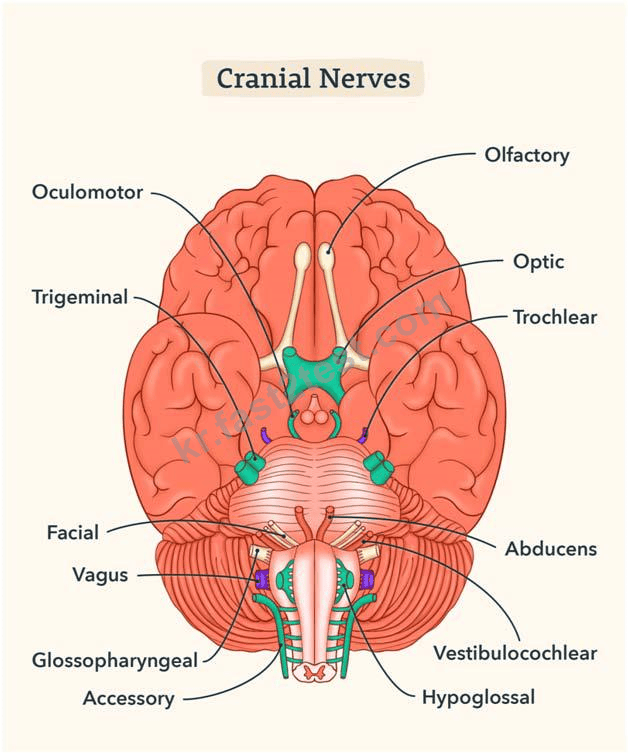
An illustration of the human brain highlights the 12 cranial nerves:
1. The olfactory nerve is located within the nasal cavity below the frontal lobe.
2. The optic nerve emerges from the optic disk in the forebrain.
3. The oculomotor nerve originates from the midbrain of the brainstem.
4. The trochlear nerve originates from the medial midbrain.
5. The trigeminal nerve emerges from the semilunar ganglion near the apex of the temporal bone.
6. The abducens is located on the floor of the fourth ventricle in pons.
7. The facial nerve emerges from pons.
8. The vestibulocochlear nerve is located in pons of the brainstem.
9. The glossopharyngeal nerve emerges from the medulla oblongata.
10. The vagus nerve arises from medulla oblongata.
11. The hypoglossal nerve originates near the top of the spinal cord at the base of the brain.
12. The accessory nerve arises from the cervical spinal cord and caudal medulla.
Reference:
Burns, Suzanne
M. AACN Essentials of Progressive Care Nursing, Fourth Edition. Pg 302.
The optic nerve controls visual fields and visual acuity; the oculomotor nerve controls most extraocular eye movements, ability to elevate eyelid, muscular contraction of the iris in response to light.
* Olfactory Nerve - I
* Optic Nerve - II
* Oculomotor Nerve - III
* Trochlear Nerve - IV
* Trigeminal Nerve - V
* Abducens Nerve - VI
* Facial Nerve - VII
* Vestibulocochlear (Auditory) Nerve - VIII
* Glossopharyngeal Nerve - IX
* Vagus Nerve - X
* Accessory Nerve - XI
* Hypoglossal Nerve - XII
An illustration of the human brain highlights the 12 cranial nerves:
1. The olfactory nerve is located within the nasal cavity below the frontal lobe.
2. The optic nerve emerges from the optic disk in the forebrain.
3. The oculomotor nerve originates from the midbrain of the brainstem.
4. The trochlear nerve originates from the medial midbrain.
5. The trigeminal nerve emerges from the semilunar ganglion near the apex of the temporal bone.
6. The abducens is located on the floor of the fourth ventricle in pons.
7. The facial nerve emerges from pons.
8. The vestibulocochlear nerve is located in pons of the brainstem.
9. The glossopharyngeal nerve emerges from the medulla oblongata.
10. The vagus nerve arises from medulla oblongata.
11. The hypoglossal nerve originates near the top of the spinal cord at the base of the brain.
12. The accessory nerve arises from the cervical spinal cord and caudal medulla.
Reference:
Burns, Suzanne
M. AACN Essentials of Progressive Care Nursing, Fourth Edition. Pg 302.
The 6-minute-walk test is used in the diagnosis of:
정답: A
설명: (Fast2test 회원만 볼 수 있음)
In this type of aortic dissection, the original tear begins in the ascending aorta and the dissection extends to the descending aorta:
정답: C
설명: (Fast2test 회원만 볼 수 있음)
A patient with a tracheostomy spontaneously opens his eyes to verbal stimuli and obeys verbal commands. His Glasgow Coma Scale score is:
정답: D
설명: (Fast2test 회원만 볼 수 있음)
Patients in renal failure often develop metabolic acidosis. Treatment is usually not initiated for this condition until the serum bicarbonate level drops to:
정답: A
설명: (Fast2test 회원만 볼 수 있음)
In sepsis, a variety of immune mechanisms occur which, if untreated, can lead to organ damage and death. The cells involved in these events are either directly involved in the immune reaction, or are stimulated to produce and release chemical mediators that extend the dysregulated response to the immune reaction. Cytokines are one group of these chemical mediators and are intended to provide a protective response.
All of the following are examples of cytokines except:
All of the following are examples of cytokines except:
정답: D
설명: (Fast2test 회원만 볼 수 있음)
Which of the following is a diagnosis-specific plan of care which focuses the entire medical team on expected patient outcomes?
정답: A
설명: (Fast2test 회원만 볼 수 있음)