
SOA Design & Architecture Lab - S90.09무료 덤프문제 풀어보기
When Service A receives a message from Service Consumer A(1),the message is
processed by Component A.
This component first invokes Component B (2), which uses values from the message to query Database A in order to retrieve additional data.
Component B then returns the additional data to Component A.
Component A then invokes Component C (3), which interacts with the API of a legacy
system to retrieve a new data value. Component C then returns the data value back to
Component A.
Next, Component A sends some of the data it has accumulated to Component D (4), which
writes the data to a text file that is placed in a specific folder. Component D then waits until
this file is imported into a different system via a regularly scheduled batch import. Upon
completion of the import, Component D returns a success or failure code back to
Component A.
Component A finally sends a response to Service Consumer A (5) containing all of the data
collected so far and Service Consumer A writes all of the data to Database B (6).
Components A, B, C.
and D belong to the Service A service architecture. Database A, the legacy system, and the file folders are shared resources within the IT enterprise.

Service A is a task service that completes an entire business task on its own without having
to compose other services. However, you have received many complaints about the
reliability of Service A . Specifically, it has three problems. First, when Component B
accesses Database A, it may not receive a response for several minutes when the
database is being accessed by other applications in the IT enterprise. Secondly, the legacy
system accessed by Component C frequently crashes and therefore becomes unavailable
for extended periods of time. Third, for Component D to respond to Component A, it must
first wait for the batch import of the files to occur. This can take several minutes during
which Service Consumer A remains stateful and consumes excessive memory. What steps
can be taken to address these three problems?
processed by Component A.
This component first invokes Component B (2), which uses values from the message to query Database A in order to retrieve additional data.
Component B then returns the additional data to Component A.
Component A then invokes Component C (3), which interacts with the API of a legacy
system to retrieve a new data value. Component C then returns the data value back to
Component A.
Next, Component A sends some of the data it has accumulated to Component D (4), which
writes the data to a text file that is placed in a specific folder. Component D then waits until
this file is imported into a different system via a regularly scheduled batch import. Upon
completion of the import, Component D returns a success or failure code back to
Component A.
Component A finally sends a response to Service Consumer A (5) containing all of the data
collected so far and Service Consumer A writes all of the data to Database B (6).
Components A, B, C.
and D belong to the Service A service architecture. Database A, the legacy system, and the file folders are shared resources within the IT enterprise.
Service A is a task service that completes an entire business task on its own without having
to compose other services. However, you have received many complaints about the
reliability of Service A . Specifically, it has three problems. First, when Component B
accesses Database A, it may not receive a response for several minutes when the
database is being accessed by other applications in the IT enterprise. Secondly, the legacy
system accessed by Component C frequently crashes and therefore becomes unavailable
for extended periods of time. Third, for Component D to respond to Component A, it must
first wait for the batch import of the files to occur. This can take several minutes during
which Service Consumer A remains stateful and consumes excessive memory. What steps
can be taken to address these three problems?
정답: B
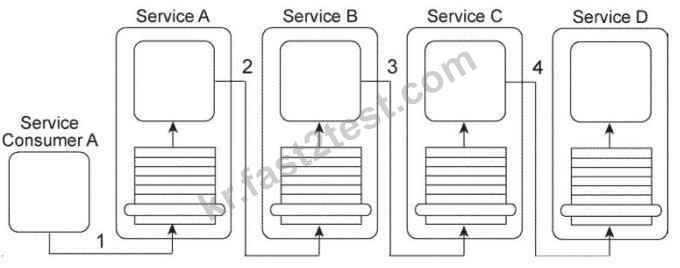
Service Consumer A sends a message to Service A (1), which then forwards the message
to Service B (2). Service B forwards the message to Service C (3), which finally forwards
the message to Service D (4).
Services A, B, and C each contain logic that reads the content of the message and, based
on this content, determines which service to forward the message to. As a result, what is
shown in the Figure is one of several possible runtime scenarios.
You are told that the current service composition architecture is having performance
problems because of two specific reasons. First, too many services need to be explicitly
invoked in order for the message to arrive at its destination. Secondly, because each of the
intermediary services is required to read the entire message contents in order to determine
where to forward the message to, it is taking too long for the overall task to complete. What
steps can be taken to solve these problems without sacrificing any of the functionality that
currently exists?
to Service B (2). Service B forwards the message to Service C (3), which finally forwards
the message to Service D (4).
Services A, B, and C each contain logic that reads the content of the message and, based
on this content, determines which service to forward the message to. As a result, what is
shown in the Figure is one of several possible runtime scenarios.
You are told that the current service composition architecture is having performance
problems because of two specific reasons. First, too many services need to be explicitly
invoked in order for the message to arrive at its destination. Secondly, because each of the
intermediary services is required to read the entire message contents in order to determine
where to forward the message to, it is taking too long for the overall task to complete. What
steps can be taken to solve these problems without sacrificing any of the functionality that
currently exists?
정답: C
Service A is a utility service that provides generic data access logic to a database that
contains data that is periodically replicated from a shared database (1). Because the
Standardized Service Contract principle was applied to the design of Service A, its service
contract has been fully standardized.
The service architecture of Service A is being accessed by three service consumers.
Service Consumer A accesses a component that is part of the Service A implementation by
invoking it directly (2). Service Consumer B invokes Service A by accessing its service
contract (3). Service Consumer C directly accesses the replicated database that is part of
the Service A implementation (4).
You've been told that the shared database will soon be replaced with a new database
product that will have new data models and new replication technology. How can the
Service A architecture be changed to avoid negative impacts that may result from the
replacement of the database and to establish a service architecture in which negative
forms of coupling can be avoided in the future?

contains data that is periodically replicated from a shared database (1). Because the
Standardized Service Contract principle was applied to the design of Service A, its service
contract has been fully standardized.
The service architecture of Service A is being accessed by three service consumers.
Service Consumer A accesses a component that is part of the Service A implementation by
invoking it directly (2). Service Consumer B invokes Service A by accessing its service
contract (3). Service Consumer C directly accesses the replicated database that is part of
the Service A implementation (4).
You've been told that the shared database will soon be replaced with a new database
product that will have new data models and new replication technology. How can the
Service A architecture be changed to avoid negative impacts that may result from the
replacement of the database and to establish a service architecture in which negative
forms of coupling can be avoided in the future?
정답: B
It has been confirmed that Policy A and Policy B are, in fact, the same policy and that the
security credential check performed by Service Agent B also needs to be carried out on
messages sent to Service B .
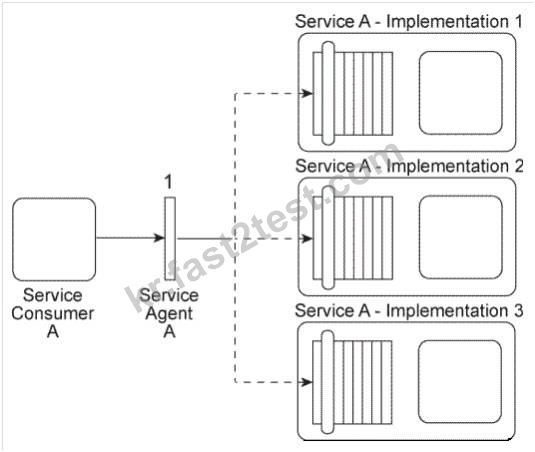
How can this service composition architecture be changed to reduce the redundancy of
policy content and fulfill the new security requirement?
security credential check performed by Service Agent B also needs to be carried out on
messages sent to Service B .
How can this service composition architecture be changed to reduce the redundancy of
policy content and fulfill the new security requirement?
정답: A