
Microsoft Implementing a Data Warehouse with Microsoft SQL Server 2012/2014 (070-463日本語版) - 070-463日本語무료 덤프문제 풀어보기
NO: 212

정답: B,C,D,E
설명: (Fast2test 회원만 볼 수 있음)

정답: A

정답: G
설명: (Fast2test 회원만 볼 수 있음)

정답: B
설명: (Fast2test 회원만 볼 수 있음)

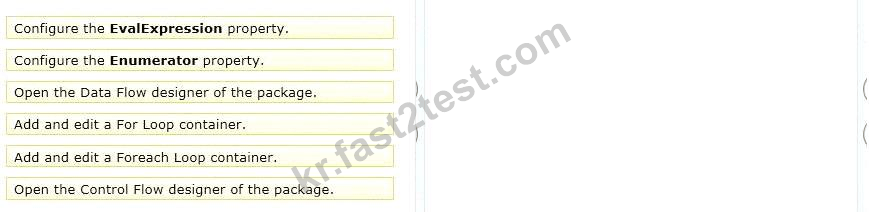
정답:

Explanation
Box 1: Open the Control Flow designer of the package.
Box 2: Add and edit a For Loop container.
Box 3: Configure the EvalExpression property.
Note:
* You create the control flow in a package by using the control flow designer.
Integration Services includes three types of containers that you can use in a control flow.
/ Foreach Loop container
/ For Loop container
/ Sequence container
* For Loop Container
The For Loop container defines a repeating control flow in a package. The loop implementation is similar to the For looping structure in programming languages. In each repeat of the loop, the For Loop container evaluates an expression and repeats its workflow until the expression evaluates to False.
The For Loop container uses the following elements to define the loop:
/ An optional initialization expression that assigns values to the loop counters.
/ An evaluation expression that contains the expression used to test whether the loop should stop or continue.
/ An optional iteration expression that increments or decrements the loop counter.

정답: B
설명: (Fast2test 회원만 볼 수 있음)

정답: C


정답:

Explanation

Running Parameterized SQL Commands
SQL statements and stored procedures frequently use input parameters, output parameters, and return codes.
The Execute SQL task supports the Input, Output, and ReturnValue parameter types. You use the Input type for input parameters, Output for output parameters, and ReturnValue for return codes.
Ref: http://msdn.microsoft.com/en-us/library/ms141003.aspx
In SSIS there are two tasks than can be used to execute SQL statements: Execute T-SQL Statement and Execute SQL. What is the difference between the two?
The Execute T-SQL Statement task tasks less memory, parse time, and CPU time than the Execute SQL task, but is not as flexible. If you need to run parameterized queries, save the query results to variables, or use property expressions, you should use the Execute SQL task instead of the Execute T-SQL Statement task.
Ref: http://www.sqlservercentral.com/blogs/ja
messerra/2012/11/08/ssis-execute-sql-task-vs-execute-t-sql-statement-task/
NO: 214
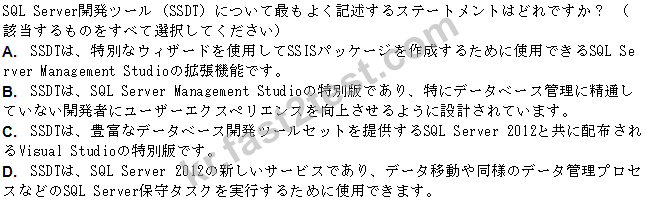
정답: A

정답: A

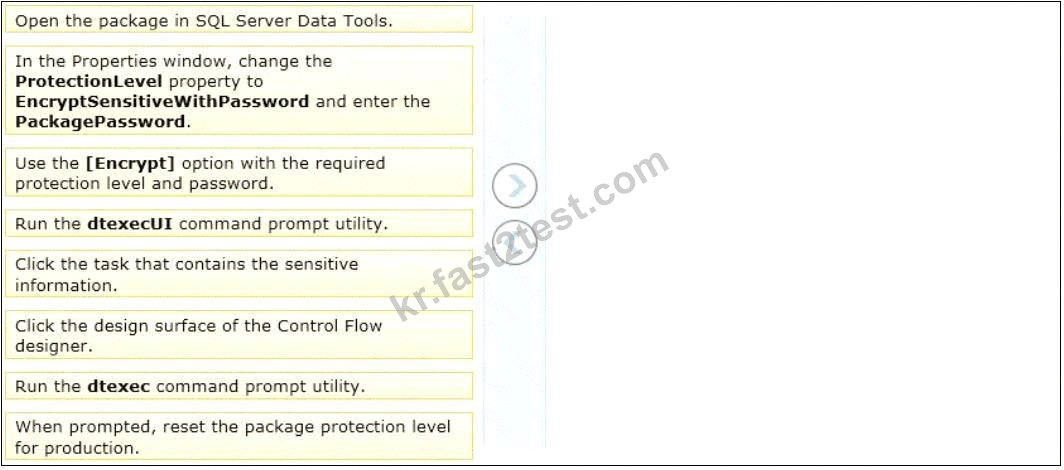
정답:

Explanation
Box 1:

Box 2:

Box 3:


정답: D